
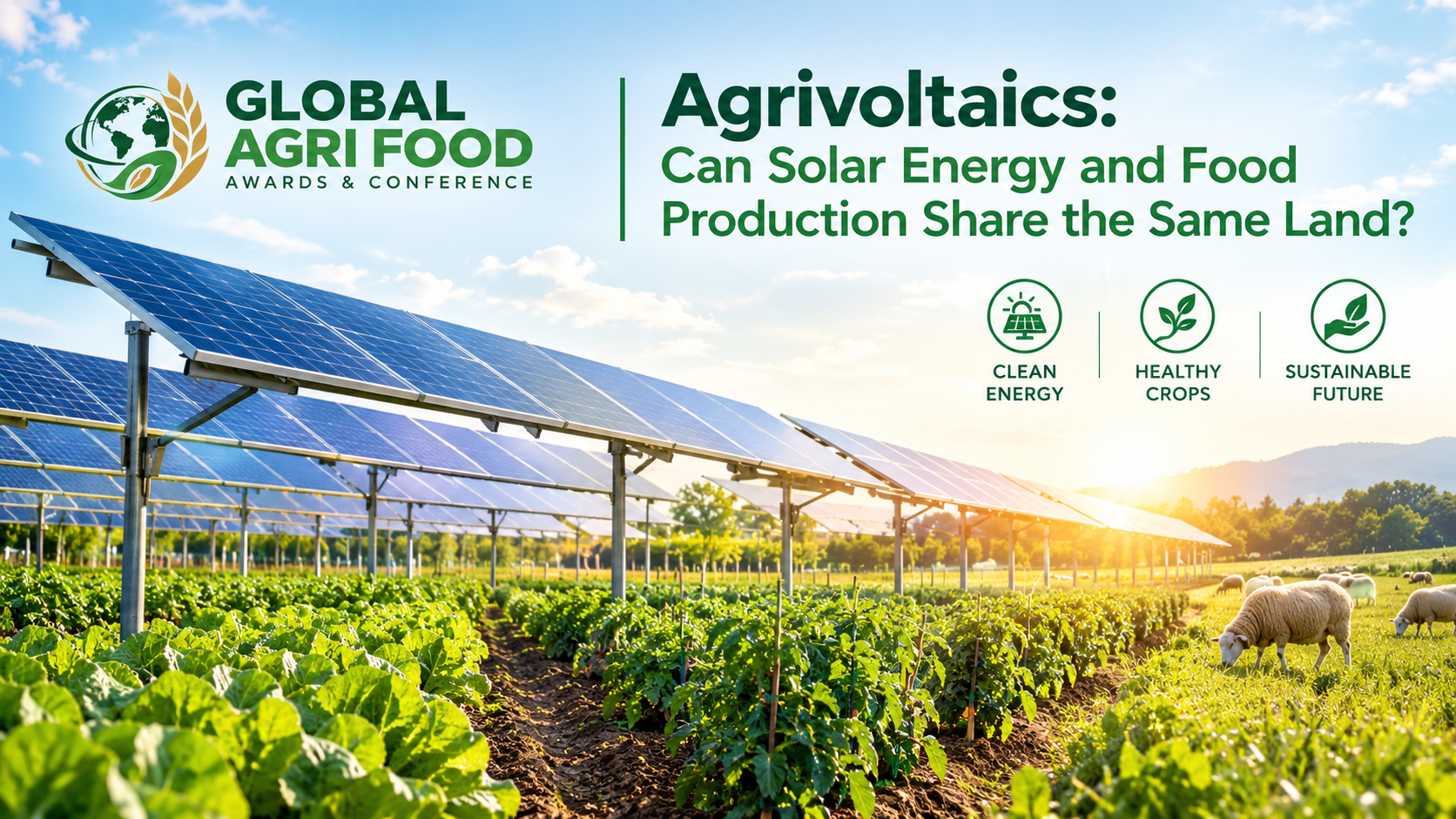
Agrivoltaics: Can Solar Energy and Food Production Share the Same Land?
Agriculture and renewable energy are two essential pillars of a sustainable future. As global demand for food and electricity continues to grow, finding ways to produce both efficiently has become an important challenge. One emerging solution is agrivoltaics, an innovative approach that combines agricultural activities with solar energy generation on the same land.
Traditionally, solar farms and agricultural fields have competed for land. Agrivoltaics offers an alternative by integrating solar panels with crop cultivation, livestock grazing, or other agricultural activities. When carefully designed, these systems can help farmers diversify their income while contributing to renewable energy production.
As climate change, rising energy costs, and pressure on agricultural resources reshape the global food system, agrivoltaics is attracting attention from farmers, researchers, policymakers, investors, and clean-energy companies.
1. What Is Agrivoltaics?
Agrivoltaics, also known as agri-solar or dual-use solar farming, involves using the same land for both agriculture and solar photovoltaic electricity generation.
Solar panels can be installed above crops, between cultivated rows, or in configurations that allow farming activities to continue beneath and around the equipment.
Depending on the system design, agricultural activities may include growing vegetables, cultivating fruit crops, maintaining pasture, or allowing livestock to graze.
The objective is to create a system in which agricultural production and renewable energy generation can coexist without unnecessarily compromising either activity.
However, agrivoltaics is not a one-size-fits-all solution. Its performance depends on crop selection, local climate, panel height, spacing, orientation, irrigation requirements, and farming practices.
Successful implementation requires careful planning to ensure that solar infrastructure supports rather than disrupts agricultural operations.
2. Why Agrivoltaics Is Gaining Attention
Agricultural land faces growing pressure from food production, urban expansion, infrastructure development, and renewable energy projects.
At the same time, farmers must manage rising input costs, unpredictable weather, water scarcity, and changing market conditions.
Agrivoltaics offers a potential way to address several of these challenges together.
By combining food production and electricity generation, farmers may be able to create additional revenue streams without converting the entire field into a conventional solar farm.
The panels may also provide partial shade, which can benefit certain crops under specific environmental conditions. In suitable locations, this shade can reduce excessive solar exposure and potentially lower water loss from the soil.
Meanwhile, electricity generated by the system may support irrigation pumps, farm machinery, cooling facilities, and other agricultural operations.
These potential benefits have made agrivoltaics an area of growing interest in sustainable agriculture and renewable energy development.
3. How Solar Panels Can Support Crop Production
The relationship between solar panels and crop growth is one of the most important aspects of agrivoltaic system design.
Plants require sunlight for photosynthesis, but the amount of light needed varies by crop. Some crops can tolerate partial shade, while others require high levels of direct sunlight to achieve optimal yields.
Agrivoltaic systems can be designed to manage light exposure by adjusting panel height, spacing, and arrangement.
For suitable crops, partial shading may help reduce heat stress during hot periods. It can also influence soil moisture by reducing direct exposure to sunlight in shaded areas.
However, too much shade can reduce photosynthesis and lower crop yields. The same system may therefore produce different results depending on the crop variety, climate, season, and farming method.
For example, leafy vegetables and certain shade-tolerant crops may be suitable for some agrivoltaic configurations, while sun-demanding crops may require more open panel arrangements.
Farmers should evaluate crop performance through local trials before investing in large-scale installations.
The goal is to find the right balance between electricity generation and agricultural productivity.
4. Improving Water Management and Climate Resilience
Water management is becoming increasingly important as agricultural regions experience droughts, irregular rainfall, and rising temperatures.
In suitable agrivoltaic systems, solar panels may reduce direct solar radiation reaching the soil and help limit evaporation in certain areas. This may support soil moisture retention, although the outcome depends on panel placement, rainfall patterns, and local conditions.
Panels can also influence how rainfall reaches the ground. Depending on their design and spacing, they may concentrate water along panel edges, creating uneven moisture distribution.
These effects must be considered when planning irrigation systems and selecting crops.
Agrivoltaics may also help protect some crops from excessive heat and direct sunlight. However, it does not automatically eliminate drought risk or reduce irrigation requirements in every situation.
For farmers in water-stressed regions, the most effective approach is to combine suitable solar infrastructure with efficient irrigation, soil management, weather monitoring, and crop selection.
This integrated approach can help improve resource management while supporting agricultural resilience.
5. Creating Additional Income Opportunities for Farmers
Agricultural income can fluctuate due to changing market prices, weather conditions, pest outbreaks, and production costs.
Agrivoltaics may provide farmers with an additional source of income through electricity sales, energy leasing agreements, or reduced expenditure on electricity.
Depending on local regulations and the business model, farmers may sell generated electricity to the grid or use it directly for farm operations.
For example, solar electricity could help power irrigation systems, refrigeration equipment, grain storage facilities, and processing machinery.
Reducing dependence on purchased electricity may improve farm economics, particularly in areas where energy costs are high or grid access is unreliable.
However, the financial benefits depend on installation costs, financing arrangements, maintenance, electricity tariffs, grid connectivity, and agricultural performance.
Farmers must also consider the cost of equipment, potential changes to farming operations, and the terms of agreements with solar developers.
A well-designed project should provide a clear economic benefit without undermining the land's primary agricultural purpose.
6. The Role of Technology in Modern Agrivoltaics
Digital technologies can help improve the performance of agrivoltaic systems by monitoring both agricultural and energy production.
Sensors can measure soil moisture, temperature, humidity, and light intensity across different areas of a field. This information can help farmers understand how panel placement affects growing conditions.
Weather stations can provide local data to support irrigation planning and crop management.
Artificial intelligence and data analytics may also help identify patterns in crop performance, electricity generation, and resource use.
For example, digital monitoring systems can compare crop growth in shaded and unshaded areas, helping farmers evaluate whether a particular panel arrangement is suitable for a crop.
Smart irrigation systems can use soil moisture readings and weather forecasts to guide water application.
Meanwhile, solar monitoring platforms can track electricity production and identify equipment performance issues.
Integrating these technologies can support more informed decisions and help farmers improve the balance between food production and renewable energy generation.
7. Agrivoltaics in Emerging Markets
Agrivoltaics may offer important opportunities in emerging markets, where agriculture supports livelihoods and demand for reliable electricity continues to grow.
In countries such as India, where many agricultural regions experience high temperatures and significant irrigation requirements, combining solar energy with farming could offer benefits in suitable locations.
Solar-powered irrigation can reduce dependence on conventional electricity or diesel-powered pumps. When combined with appropriate agrivoltaic designs, solar infrastructure may also create opportunities for dual-use land management.
In parts of Africa, agrivoltaic projects could support agricultural communities facing energy access challenges, provided that systems are affordable and adapted to local farming practices.
However, implementation requires careful consideration of land ownership, access to finance, grid infrastructure, water availability, crop selection, and local agricultural needs.
Projects must also ensure that farmers retain meaningful benefits and that agricultural land is not diverted from food production without adequate evaluation.
Local research, pilot projects, and farmer participation are essential to identifying models that work in different regions.
8. Challenges and Limitations of Agrivoltaics
Although agrivoltaics offers promising opportunities, several challenges must be addressed before it can become widely adopted.
High initial investment
Installing solar panels, support structures, electrical equipment, and monitoring systems can require substantial capital. Financing options must reflect farmers' financial circumstances and expected returns.
Complex system design
Panel height, spacing, orientation, and equipment access must be planned around agricultural operations. Poor design can interfere with machinery, harvesting, irrigation, and crop growth.
Crop-specific requirements
Not all crops benefit from partial shading. Crop selection must reflect local sunlight conditions, temperatures, water availability, and seasonal requirements.
Maintenance and operational access
Solar installations need regular maintenance, while agricultural fields require routine cultivation and harvesting. System designs must accommodate both activities.
Land-use and ownership concerns
Projects involving third-party solar developers may create questions about land access, lease agreements, revenue sharing, and long-term control of agricultural land.
Limited local evidence
Agrivoltaic performance can vary considerably between locations. More field trials and long-term studies are needed to determine which configurations deliver the best combined outcomes.
Addressing these issues requires cooperation among farmers, agricultural scientists, engineers, energy companies, policymakers, and financial institutions.
9. Investment and Business Opportunities
Agrivoltaics creates opportunities across agriculture, renewable energy, technology, and infrastructure.
Potential areas for investment include:
Solar infrastructure: Developing panel systems designed to accommodate agricultural activities.
Smart irrigation: Integrating solar electricity with efficient water management systems.
Digital monitoring: Providing sensors and software to track crop and energy performance.
Agricultural research: Testing crop varieties and growing methods suitable for partially shaded environments.
Farm energy services: Developing business models that allow farmers to use or sell renewable electricity.
Project development: Supporting feasibility studies, financing, installation, and long-term maintenance.
Agricultural processing: Using renewable electricity to support cold storage, food processing, and other value-added activities.
For agritech startups, agrivoltaics offers an opportunity to develop integrated solutions that address agricultural productivity and energy efficiency together.
Investors, however, should assess both sides of the business model. Strong electricity generation does not necessarily guarantee successful agriculture, and good crop performance alone may not make a project financially viable.
Projects should be evaluated using combined measures of agricultural output, electricity generation, operating costs, environmental performance, and farmer income.
10. The Future of Agrivoltaics
The future of agrivoltaics will depend on the ability to design systems that meet the needs of both farmers and energy producers.
Advances in solar panel efficiency, structural engineering, digital monitoring, and crop science may create more flexible system designs.
Researchers are exploring different panel heights, spacing arrangements, and technologies that can help manage light exposure while maintaining access for agricultural machinery.
Improved data collection may also help identify crops and farming methods suited to particular agrivoltaic configurations.
In the coming years, partnerships between agricultural institutions, renewable energy companies, technology providers, and farming communities will be important in expanding practical applications.
Policymakers can contribute by establishing clear land-use guidelines, supporting research, improving access to financing, and creating frameworks that protect agricultural interests.
Ultimately, the most effective projects will be those designed around local conditions rather than relying on a universal model.
Conclusion
Agrivoltaics represents an innovative approach to combining food production with renewable energy generation. By allowing agriculture and solar infrastructure to share land, it may create additional income opportunities, support farm energy needs, and improve resource management in suitable environments.
However, success depends on thoughtful design, appropriate crop selection, reliable financing, and careful evaluation of agricultural and energy outcomes.
For farmers, agribusinesses, agritech companies, and renewable energy developers, agrivoltaics offers an opportunity to explore new forms of collaboration and more integrated land use.
As the global food and energy systems continue to evolve, agrivoltaics could become an important part of building more resilient, resource-efficient, and innovative agricultural systems.
Global Agri Food Awards & Conference 2027
The Global Agri Food Awards & Conference (GAFC) brings together agricultural innovators, agritech companies, food industry professionals, investors, and industry leaders to explore emerging technologies and opportunities shaping the future of agriculture and food.
From renewable energy and climate-smart farming to digital agriculture and sustainable food production, collaboration across industries will be essential to developing practical solutions for tomorrow's challenges.
GAFC provides a platform for industry professionals to exchange insights, explore partnerships, and discuss innovations across the global agri-food value chain.
Upcoming editions:
Dubai, UAE: 13–14 April 2027
Amsterdam, Netherlands: 14–15 September 2027
Learn more: globalagrifoodconference.com