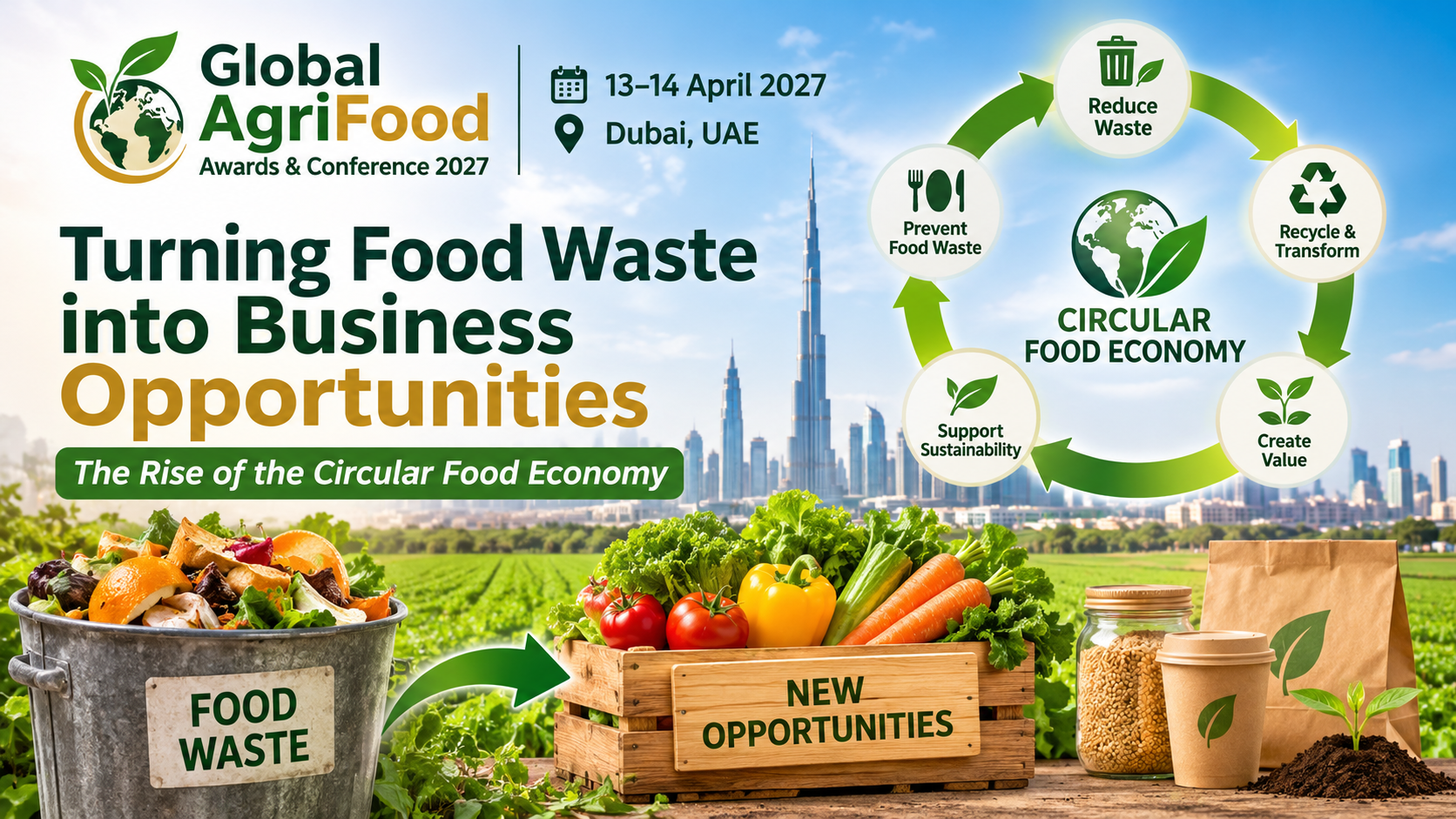
Turning Food Waste into Business Opportunities: The Rise of the Circular Food Economy
Global AgriFood Awards & Conference 2027 | Agriculture & Food Innovation
Introduction
Food waste is one of the biggest challenges facing the global food system. Every year, significant quantities of food are lost or discarded during harvesting, processing, transportation, retail, and consumption. While food waste creates environmental and economic challenges, it also presents an opportunity for businesses to develop innovative products, create new revenue streams, and build more sustainable supply chains.
The traditional food production model follows a linear approach: produce, process, distribute, consume, and discard. However, the growing focus on sustainability is encouraging businesses to adopt a circular food economy, where food resources are used more efficiently and waste materials are transformed into valuable products.
From converting agricultural residues into bioenergy to transforming surplus food into new consumer products, businesses are discovering that food waste can become a valuable resource.
Understanding the Circular Food Economy
A circular food economy focuses on reducing waste, extending the life of resources, and recovering value from materials that would otherwise be discarded.
Rather than treating food waste as an unavoidable by-product, this approach encourages businesses to rethink how food is produced, processed, distributed, and consumed.
The circular food economy is built around several important principles:
Prevent food waste: Improve production planning, storage, inventory management, and distribution.
Redistribute surplus food: Connect businesses with food banks, charities, and communities.
Reuse food by-products: Convert discarded ingredients and agricultural residues into new products.
Recover resources: Transform unavoidable organic waste into compost, bioenergy, and other useful materials.
Improve resource efficiency: Reduce water, energy, packaging, and raw material consumption.
These practices can help businesses reduce operational costs while supporting environmental sustainability.
1. Turning Agricultural Waste into Valuable Products
Agricultural production generates significant quantities of by-products, including crop residues, fruit peels, vegetable waste, husks, and other organic materials.
Instead of disposing of these materials, innovative businesses are finding ways to transform them into commercially valuable products.
For example:
Rice husks can be used in bioenergy production and other industrial applications.
Fruit and vegetable peels can be processed into natural ingredients and extracts.
Crop residues can be converted into compost and soil improvement products.
Agricultural by-products can be developed into animal feed ingredients where suitable and safe.
Plant-based waste can provide raw materials for biodegradable packaging.
These opportunities demonstrate how agricultural waste can become an additional source of value for farmers, food processors, and manufacturers.
2. Food Processing Innovation Is Creating New Markets
Food processing companies are increasingly exploring ways to use ingredients that were previously considered waste.
Surplus fruits, vegetables, and other food materials can be transformed into juices, powders, sauces, snacks, natural flavouring ingredients, and other food products.
For example, imperfect fruits that do not meet retail appearance standards may still be suitable for processing. Similarly, certain food production by-products can be used to develop high-fibre ingredients, plant-based products, and functional food components.
This approach creates opportunities for food manufacturers to diversify their product portfolios while improving the utilisation of available resources.
3. Technology Is Helping Businesses Reduce Food Waste
Technology is becoming an important part of food waste prevention and management.
Artificial intelligence, automation, data analytics, and digital platforms are helping businesses identify inefficiencies throughout the food supply chain.
Some important applications include:
Artificial intelligence and predictive analytics: Businesses can analyse demand patterns, inventory levels, and purchasing behaviour to improve production planning and reduce overproduction.
Smart storage systems: Temperature and humidity monitoring technologies help maintain product quality and reduce spoilage during storage and transportation.
Digital food marketplaces: Online platforms connect businesses with buyers interested in surplus food, helping redirect products that might otherwise be discarded.
Automated sorting systems: Advanced technologies help identify, classify, and separate food products according to quality and processing requirements.
By combining these technologies, companies can improve operational efficiency and make better use of their resources.
4. The Business Opportunity in Food Waste Recycling
Food waste management is developing into a growing area of business innovation.
Companies are exploring commercial opportunities in organic waste collection, recycling, composting, anaerobic digestion, and bioenergy production.
Some promising business areas include:
Organic fertiliser and compost manufacturing.
Biogas production from suitable organic waste.
Sustainable packaging made from agricultural residues.
Food waste collection and processing services.
Technology platforms connecting food suppliers with surplus food buyers.
Waste management solutions for supermarkets, restaurants, and food manufacturers.
These opportunities can create partnerships between agricultural producers, technology companies, food manufacturers, waste management providers, and investors.
However, commercial success depends on factors such as reliable waste supply, processing costs, product quality, regulatory requirements, and access to suitable markets.
5. Reducing Food Waste Across the Supply Chain
Food waste does not occur only at the consumer level. It can happen at every stage of the supply chain.
During harvesting, inadequate equipment and handling practices can result in crop losses. During transportation, poor infrastructure and unsuitable storage conditions can affect food quality. At the retail level, inaccurate demand forecasting and inventory management can contribute to unsold products.
Businesses can address these challenges through:
Better post-harvest handling and storage facilities.
Improved cold-chain infrastructure.
Digital inventory and demand forecasting systems.
More efficient packaging and transportation.
Partnerships with food redistribution organisations.
Greater coordination between producers, retailers, and processors.
A connected food supply chain can help reduce avoidable losses while improving the availability and quality of food products.
6. The Role of Sustainable Packaging
Packaging plays an important role in protecting food products and extending shelf life. However, conventional packaging materials can create environmental challenges.
Businesses are increasingly exploring alternatives made from renewable and agricultural resources.
Examples include packaging developed from plant fibres, agricultural residues, and other biodegradable materials. Some companies are also investigating edible coatings and innovative packaging technologies designed to maintain food freshness.
The opportunity is not simply to replace traditional packaging but to develop solutions that balance food protection, cost, performance, and environmental impact.
7. Investment Opportunities in the Circular Food Economy
The transition towards circular food systems is creating opportunities for entrepreneurs, investors, and established businesses.
Investment areas include:
Agritech startups developing food waste prevention technologies.
Companies converting agricultural residues into industrial materials.
Food processing businesses using surplus ingredients.
Organic fertiliser and bioenergy manufacturers.
Cold-chain and smart storage infrastructure.
Digital platforms supporting food redistribution.
Sustainable packaging research and manufacturing.
For investors, the sector offers opportunities to support businesses addressing real challenges across agriculture and food production.
However, investment decisions should consider the commercial scalability of technologies, operational costs, regulatory conditions, and the availability of long-term customers.
8. Challenges Businesses Must Overcome
Despite its potential, building a circular food economy requires overcoming several practical challenges.
Infrastructure limitations: Efficient food waste collection, transportation, storage, and processing require appropriate infrastructure.
High initial investment: Processing facilities, advanced machinery, and recycling technologies may involve significant upfront costs.
Quality and safety standards: Recovered food ingredients and by-products must meet applicable food safety and quality requirements before commercial use.
Market demand: Businesses need reliable customers for products developed from recovered materials.
Awareness and collaboration: Farmers, manufacturers, retailers, consumers, and policymakers must work together to reduce waste and improve resource utilisation.
Addressing these challenges will require collaboration, innovation, investment, and supportive policies.
9. What the Future Holds for the Circular Food Economy
The future of the circular food economy will depend on how effectively businesses integrate sustainability into their operations.
Artificial intelligence, advanced processing technologies, biotechnology, and improved supply chain management are likely to play important roles in reducing food losses and recovering value from unused resources.
Agricultural producers may increasingly work with food manufacturers to develop markets for crop residues and other by-products. Food companies may redesign production processes to reduce waste from the beginning. Meanwhile, technology startups can help connect different participants through digital platforms and resource-sharing solutions.
The biggest opportunity lies in changing how businesses view food waste: not simply as a disposal problem, but as a resource that can support innovation, efficiency, and new commercial opportunities.
Conclusion
Turning food waste into business opportunities is becoming an important part of building a more sustainable and resilient global food system.
From agricultural waste recycling and innovative food processing to AI-powered supply chains and sustainable packaging, the circular food economy offers opportunities across the entire agriculture and food value chain.
Businesses that invest in resource efficiency and innovative waste management solutions can reduce unnecessary losses, develop new products, and contribute to more responsible food production.
The next stage of food industry innovation will not only focus on producing more food, but also on making better use of the resources already available.
Join the Global AgriFood Awards & Conference 2027
The Global AgriFood Awards & Conference 2027 will bring together agricultural leaders, food industry professionals, agritech innovators, entrepreneurs, investors, and sustainability experts to discuss the future of agriculture and the global food industry.
Global AgriFood Awards & Conference 2027
13–14 April 2027
Dubai, UAE
Key discussion areas
Circular food economy and food waste reduction
Sustainable agriculture and food production
Agritech innovation and investment
Food processing and supply chain transformation
Agricultural technology and global food security
Sustainable packaging and resource efficiency
Learn more about the event, its programme, and participation opportunities.
The conference provides an opportunity to exchange ideas, explore emerging technologies, build industry connections, and contribute to conversations shaping the future of the global agri-food sector.