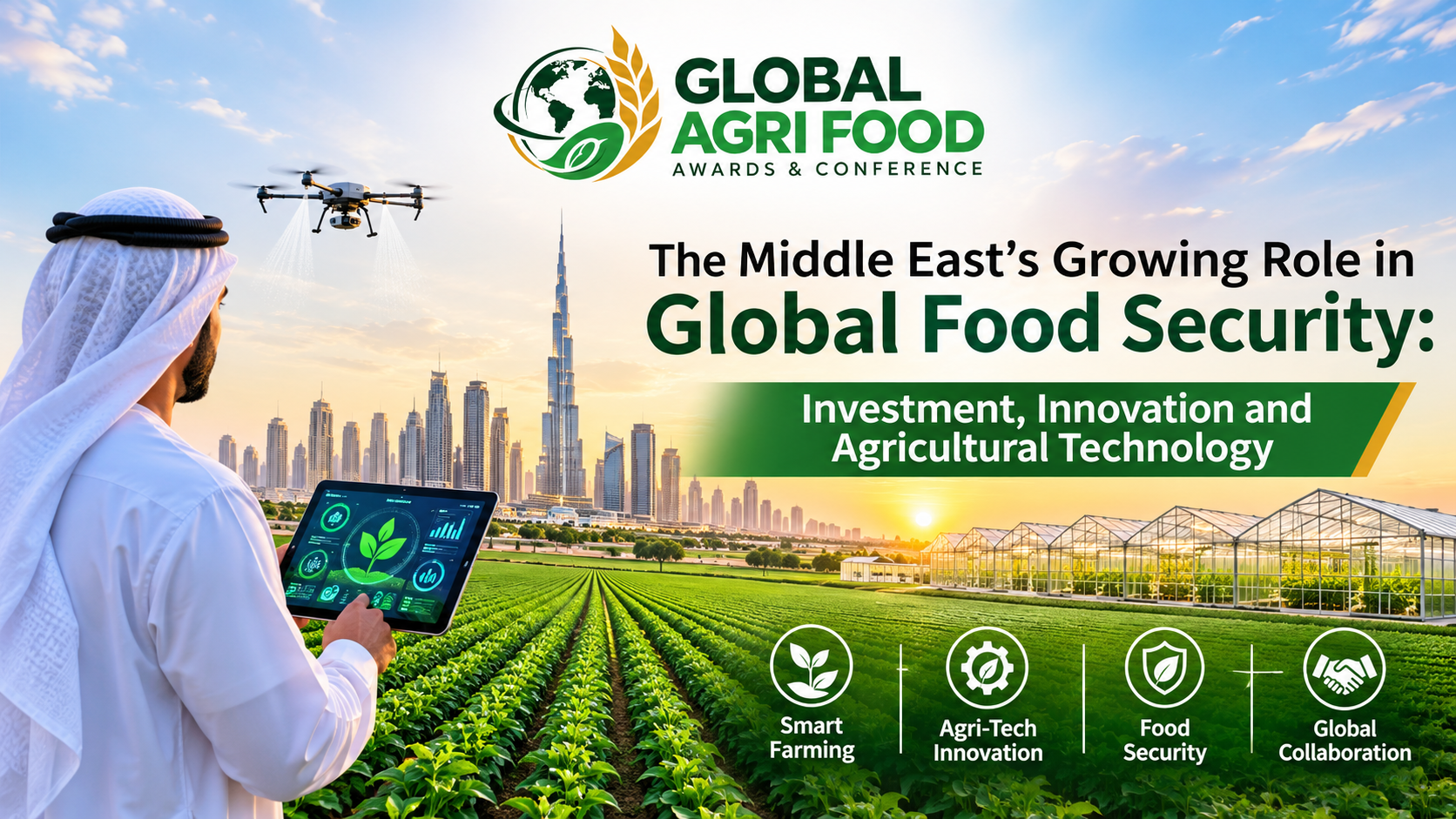
The Middle East's Growing Role in Global Food Security: Investment, Innovation and Agricultural Technology
Global AgriFood Conference 2027 | Industry Insights
Introduction
Food security has become one of the most important global priorities as countries face increasing pressure from climate change, water scarcity, population growth, supply chain disruptions, and changing food consumption patterns. These challenges are particularly significant in the Middle East, where limited agricultural land and scarce freshwater resources make food production increasingly complex.
Despite these limitations, the region is emerging as an important player in the global food and agriculture industry. Governments, investors, agritech companies, and food businesses are exploring new ways to strengthen domestic food production, diversify food imports, and adopt advanced agricultural technologies.
Countries such as the United Arab Emirates and Saudi Arabia are investing in agricultural innovation, controlled-environment farming, food processing, and supply chain infrastructure. These developments are creating new opportunities for businesses and investors while contributing to broader discussions about the future of global food security.
1. Why Food Security Is Becoming a Strategic Priority in the Middle East
The Middle East relies significantly on international food supply chains to meet domestic demand. This dependence makes the region vulnerable to global price fluctuations, transportation disruptions, geopolitical tensions, and extreme weather events affecting major agricultural producing countries.
As a result, food security is increasingly viewed as a strategic economic and national priority rather than simply an agricultural issue.
Governments are focusing on several key areas:
Strengthening domestic food production.
Diversifying international food sourcing.
Improving food storage and distribution infrastructure.
Reducing food loss and waste.
Supporting agricultural research and innovation.
Encouraging private-sector investment in food systems.
The objective is to build more resilient and diversified food systems.
2. Agricultural Technology Is Changing the Region's Farming Landscape
Technology is playing an increasingly important role in overcoming agricultural limitations across the Middle East.
Traditional farming methods often require significant water resources and suitable climatic conditions. New agricultural technologies are helping businesses improve production efficiency while making better use of available resources.
Some of the most promising developments include:
Artificial Intelligence and Data Analytics: AI-powered platforms can analyse weather conditions, monitor crop health, identify potential diseases, and support better farming decisions.
Precision Agriculture: Sensors, satellite imagery, and automated monitoring systems help farmers understand soil conditions, manage irrigation, and apply agricultural inputs more efficiently.
Smart Irrigation: Advanced irrigation systems can monitor moisture levels and deliver water according to crop requirements, helping reduce unnecessary water consumption.
These technologies are creating opportunities for agritech startups, technology providers, agricultural investors, and established food businesses.
3. Controlled-Environment Agriculture: Growing Food in Challenging Climates
One of the most promising developments in the Middle East is controlled-environment agriculture.
This approach includes hydroponics, vertical farming, greenhouse cultivation, and other indoor farming systems that allow crops to grow under carefully managed conditions.
These technologies can help address some of the region's biggest agricultural challenges:
Limited availability of fertile land.
High outdoor temperatures.
Water scarcity.
Seasonal limitations on crop production.
Dependence on imported fresh produce.
However, commercial success depends on more than production capacity. Energy consumption, infrastructure costs, crop selection, distribution, and consumer demand must also be considered.
4. Investment Opportunities Across the AgriFood Value Chain
The expansion of food security initiatives is creating investment opportunities beyond traditional farming.
Investors are increasingly looking at businesses that can improve the efficiency, reliability, and sustainability of the entire food value chain.
Important investment areas include:
Agritech startups: AI-powered farming, smart irrigation and agricultural robotics.
Food processing: Advanced preservation, packaging and storage technologies.
Cold chain infrastructure: Temperature-controlled logistics to reduce food spoilage.
Aquaculture: Sustainable fish farming and seafood production.
Agricultural biotechnology: Innovations in seeds, biological crop protection and soil health.
These developments demonstrate the growing commercial potential of the global agrifood sector.
5. Saudi Arabia's Growing Role in Agricultural Innovation
Saudi Arabia is another important example of how the Middle East is investing in agricultural development and food security.
Under Saudi Vision 2030, the country is working to strengthen domestic food production, improve water efficiency, support agricultural research, and develop international partnerships.
The Kingdom is also exploring technologies such as:
Smart irrigation and water-management systems.
Protected agriculture and modern greenhouses.
Aquaculture and integrated farming.
Drone and satellite-based crop monitoring.
AI-powered agricultural solutions.
These developments demonstrate how government initiatives and private-sector collaboration can support the transformation of regional food systems.
6. International Partnerships Are Essential for Long-Term Food Security
Food security cannot be achieved by individual countries working independently.
Agriculture is a global industry, and food production, processing, transportation, and distribution depend on international cooperation.
For Middle Eastern economies, partnerships with agricultural producers, technology companies, research institutions, and international investors are particularly important.
Such collaborations can help countries access advanced agricultural technologies, diversify food import sources, develop international agricultural investment projects, and build more reliable supply chains.
7. The Challenges That Businesses Must Address
Despite growing investment and technological progress, several challenges remain.
High Operational Costs: Indoor farming, advanced greenhouses, and automated agricultural systems require significant initial investment.
Energy Consumption: Climate-controlled farming facilities can require substantial electricity.
Water Management: Even water-efficient technologies require responsible sourcing and management.
Technology Adoption: Smaller farms may struggle to afford advanced equipment or access technical expertise.
Commercial Scalability: A successful pilot project does not automatically translate into a profitable large-scale business.
Addressing these challenges will require cooperation between governments, investors, technology providers, farmers, and food businesses.
8. What Does the Future Hold for Middle Eastern Food Security?
The future of food security in the Middle East will depend on the successful integration of agricultural technology, international trade, investment, and sustainable resource management.
Several developments are expected to shape the sector:
Greater adoption of AI-powered agricultural systems.
Expansion of hydroponics and controlled-environment farming.
Increased investment in food processing and preservation.
More efficient water and energy management.
Stronger international agricultural partnerships.
Greater focus on food supply chain resilience.
The region's ambition is not simply to increase food production. It is to build food systems that can respond effectively to changing economic, environmental, and geopolitical conditions.
Conclusion
The Middle East is becoming an increasingly important part of the global conversation about food security. Through investments in agricultural technology, sustainable farming, food infrastructure, and international partnerships, countries across the region are working to address long-standing challenges and create new opportunities.
As the global food industry continues to evolve, collaboration between governments, investors, agritech innovators, researchers, and food businesses will be essential.
The next generation of food systems will require more than technological advancement. It will require practical solutions, commercial viability, responsible investment, and strong international cooperation.
Global AgriFood Awards & Conference 2027
The growing importance of food security, agricultural innovation, and sustainable food systems makes international collaboration more important than ever.
The Global AgriFood Awards & Conference 2027 will bring together industry leaders, agricultural innovators, agritech entrepreneurs, investors, policymakers, researchers, and food industry professionals to exchange knowledge, explore emerging opportunities, and discuss the future of the global agriculture and food industry.
Global AgriFood Awards & Conference 2027
Upcoming international conference
Event dates
13–14 April 2027
Location
Dubai, United Arab Emirates
Who should attend?
Agribusiness leaders, CEOs, founders, investors, policymakers, researchers and agricultural professionals.
Key discussion areas
Agricultural technology and innovation
Global food security
Sustainable agriculture
Agritech investment and entrepreneurship
Food processing and supply chain innovation
Future of farming and food production
Visit Official Website
13–14 April 2027 | Dubai, UAE
Join the conversation and be part of an international platform bringing together the people, ideas, and innovations shaping the future of the global agrifood industry.
SEO Details
Element | Content |
|---|---|
SEO title | The Middle East's Growing Role in Global Food Security |
Meta description | Explore how the Middle East is transforming global food security through agritech investment, smart farming, sustainable agriculture and innovation. |
URL slug |
|
Primary keyword | Middle East food security |
Category | Agriculture & Food Innovation |
Tags | Agritech, Food Security, UAE, Saudi Arabia, Agricultural Investment, Smart Farming |
Recommended: Use the article title as your H1, and include the conference details as a dedicated event section near the end. This gives the article both SEO value and a natural connection to your upcoming event.