
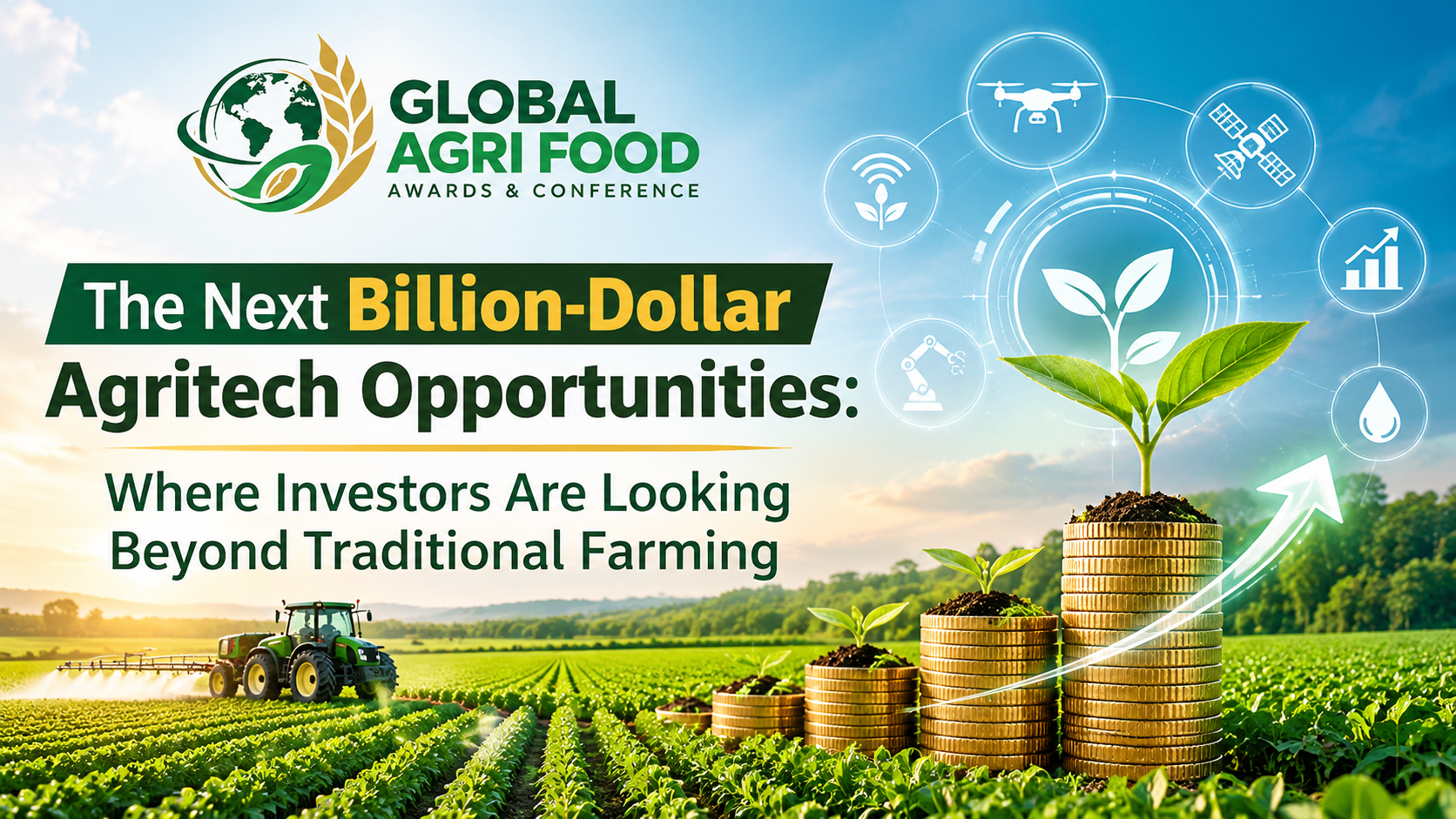
The Next Billion-Dollar Agritech Opportunities: Where Investors Are Looking Beyond Traditional Farming
Category: Agritech Innovation | Investment | Sustainable Agriculture
Meta Description: Discover the emerging agritech investment opportunities transforming global agriculture, from AI-powered farming and precision agriculture to biological solutions, smart irrigation and alternative food systems.
Suggested URL Slug: next-billion-dollar-agritech-investment-opportunities
Introduction: Agriculture Is Entering a New Investment Era
Agriculture is undergoing a significant transformation. Growing food demand, climate uncertainty, water scarcity, changing consumer expectations and pressure on agricultural productivity are creating new opportunities for innovation and investment.
For decades, agricultural investment primarily focused on land, machinery, seeds, fertilizers and traditional farming infrastructure. Today, the landscape is expanding. Artificial intelligence, robotics, biotechnology, precision farming, digital supply chains and climate-smart solutions are attracting attention from investors, entrepreneurs and established agribusinesses.
The next generation of agritech companies is not simply developing new farming tools. They are building solutions to some of the world's most important challenges: producing more food with fewer resources, reducing waste, improving supply chain efficiency and making agriculture more resilient.
But where are the biggest opportunities emerging, and what will make the next generation of agritech businesses successful?
1. Artificial Intelligence and Data-Driven Agriculture
Artificial intelligence is becoming an important part of modern agricultural operations.
Farmers and agribusinesses can use AI-powered platforms to analyze weather patterns, monitor crop health, identify potential diseases and make more informed decisions about irrigation and resource management.
Combining satellite imagery, sensors, drones and machine learning can help transform large volumes of agricultural data into practical insights.
Investment opportunity: Startups developing AI-powered farm management platforms, predictive analytics, automated crop monitoring and intelligent agricultural decision-support systems.
The strongest opportunities will likely come from solutions that demonstrate measurable improvements in productivity, reduce operational costs and are accessible to farmers of different scales.
2. Precision Agriculture and Smart Farming Equipment
Traditional farming methods often apply water, fertilizers and crop protection products uniformly across entire fields. However, different areas of the same farm can have different requirements.
Precision agriculture addresses this challenge by using technology to understand and manage field-level variations.
GPS-guided equipment, soil sensors, agricultural drones and variable-rate application systems allow farmers to make more targeted decisions.
For investors, this creates opportunities in:
Smart agricultural machinery and automation.
Soil monitoring and field intelligence.
Drone-based crop analysis.
Precision irrigation technologies.
Connected farm management systems.
As these technologies become more accessible, precision agriculture could play an increasingly important role in improving resource efficiency and farm profitability.
3. Biological Solutions and Sustainable Crop Protection
Agriculture is increasingly exploring alternatives and complementary approaches to conventional chemical inputs.
Biological crop protection, microbial fertilizers, biostimulants and soil health technologies are gaining attention as agricultural businesses look for solutions that support productivity and environmental sustainability.
These innovations can help improve nutrient availability, support plant resilience and contribute to healthier soil management when appropriately developed and applied.
Investment opportunity: Companies developing microbial technologies, biological crop protection products, advanced seed treatments and sustainable soil health solutions.
The commercial potential of this sector depends on scientific validation, consistent product performance, regulatory approval and the ability to scale manufacturing and distribution.
4. Smart Irrigation and Water Management Technologies
Water availability is one of the most important challenges facing agriculture, particularly in regions experiencing drought, water stress and unpredictable rainfall.
Smart irrigation technologies can help farmers monitor soil moisture, track water requirements and optimize irrigation schedules.
Emerging solutions include automated irrigation systems, remote sensing, water recycling technologies and AI-supported water management platforms.
For investors, water-focused agritech offers opportunities across both agricultural production and infrastructure.
Companies that can demonstrate reliable water savings while maintaining crop performance may become valuable partners for farms, governments and commercial agricultural operators.
5. Vertical Farming and Controlled Environment Agriculture
Controlled environment agriculture is creating new possibilities for growing crops in locations where conventional farming faces limitations.
Vertical farms, hydroponics, aeroponics and advanced greenhouse systems can provide greater control over temperature, humidity, lighting and nutrient delivery.
These technologies are particularly relevant for urban food production and regions with limited arable land.
However, commercial success requires careful management of energy consumption, operating expenses, crop selection and market demand.
Investors are increasingly interested in businesses that can demonstrate efficient production models rather than simply showcase innovative growing facilities.
6. Agricultural Robotics and Autonomous Operations
Labor availability and rising operational costs are encouraging interest in agricultural automation.
Robotics can support activities such as planting, harvesting, weeding, crop monitoring and sorting. Autonomous machinery may also help farms improve operational efficiency and reduce dependence on repetitive manual tasks.
Potential investment opportunities include:
Autonomous tractors and agricultural vehicles.
Robotic harvesting systems.
Automated weed detection and removal.
AI-powered sorting and grading equipment.
Robotic greenhouse management.
The next stage of agricultural automation will depend on affordability, reliability and the ability to operate in different farming environments.
7. Digital Supply Chains and Agricultural Marketplaces
Agricultural innovation does not end when crops leave the farm.
Farmers, distributors, processors, retailers and consumers all depend on efficient supply chains. However, fragmented logistics, limited market information, storage challenges and food losses can reduce the value of agricultural production.
Digital platforms can improve connections between producers and buyers, strengthen traceability and provide better visibility across the supply chain.
Investment opportunities include digital agricultural marketplaces, logistics platforms, cold-chain monitoring, food traceability systems and post-harvest management technologies.
Businesses that improve market access and reduce inefficiencies can create value across the wider agrifood ecosystem.
8. Alternative Proteins and Next-Generation Food Innovation
The future of agriculture is also closely connected to innovation in food production.
Alternative proteins, precision fermentation, plant-based ingredients and other emerging food technologies are creating opportunities for companies looking to diversify food production systems.
These innovations are attracting interest from food manufacturers, biotechnology companies and investors exploring new ways to meet changing consumer needs.
However, affordability, taste, nutritional quality, regulatory requirements and manufacturing scale remain important considerations for commercial adoption.
What Will Make an Agritech Startup Attractive to Investors?
Technology alone does not guarantee commercial success. Investors increasingly need to understand how an innovation solves a real problem and creates a sustainable business model.
Several factors can influence investment decisions:
1. Demonstrated market demand: The solution addresses a clearly identified problem faced by farmers, agribusinesses or food producers.
2. Commercial scalability: The technology can expand across different markets, crops, regions and customer segments.
3. Measurable impact: The business can demonstrate improvements in productivity, resource efficiency, profitability or supply chain performance.
4. Strong partnerships: Collaboration with agricultural businesses, research institutions, distributors and governments can support market adoption.
5. Financial sustainability: The company has a realistic revenue model, manageable operating costs and a clear path towards profitability.
Agritech businesses that combine technological innovation with practical commercial value are better positioned to build long-term market opportunities.
The Role of Global Collaboration in Agritech Investment
Agriculture is a global industry, and many of its biggest challenges require international cooperation.
A technology developed in one country may have significant potential in another. However, successful expansion requires an understanding of local farming conditions, regulations, infrastructure, market requirements and farmer needs.
Collaboration between startups, investors, established agribusinesses, universities, research organizations and policymakers can accelerate innovation and commercial adoption.
Industry conferences and international networking platforms also play an important role by bringing these stakeholders together to exchange knowledge, explore partnerships and identify emerging opportunities.
Conclusion: Investing in the Future of Food
The next wave of agritech investment will extend far beyond traditional agricultural machinery and inputs. Artificial intelligence, precision agriculture, biological solutions, smart water management, robotics and digital food supply chains are opening new possibilities across the global agrifood industry.
However, the companies that create lasting value will be those that move beyond promising technology and deliver practical, scalable and commercially sustainable solutions.
As global food demand continues to evolve, investing in agricultural innovation is not simply about supporting new businesses. It is about helping build a more productive, resilient and sustainable food system.
The future of agriculture will be shaped by those who can connect innovation with real-world impact.
Global AgriFood Awards & Conference 2027
Growtech Middle East (AgraME) | 26 - 28 Oct 26 | Premier Agriculture & Agri-Tech Expo in Dubai
The Global AgriFood Awards & Conference 2027 brings together industry leaders, agritech innovators, entrepreneurs, investors and decision-makers to explore the developments shaping the future of agriculture and food production.
The conference provides a platform for knowledge exchange, industry networking, business collaboration and discussions around innovation, sustainability and global food security.
Global AgriFood Awards & Conference 2027
13–14 April 2027
Dubai, UAE
Explore opportunities to connect with global agrifood professionals, share insights and contribute to conversations shaping the future of food and agriculture.