
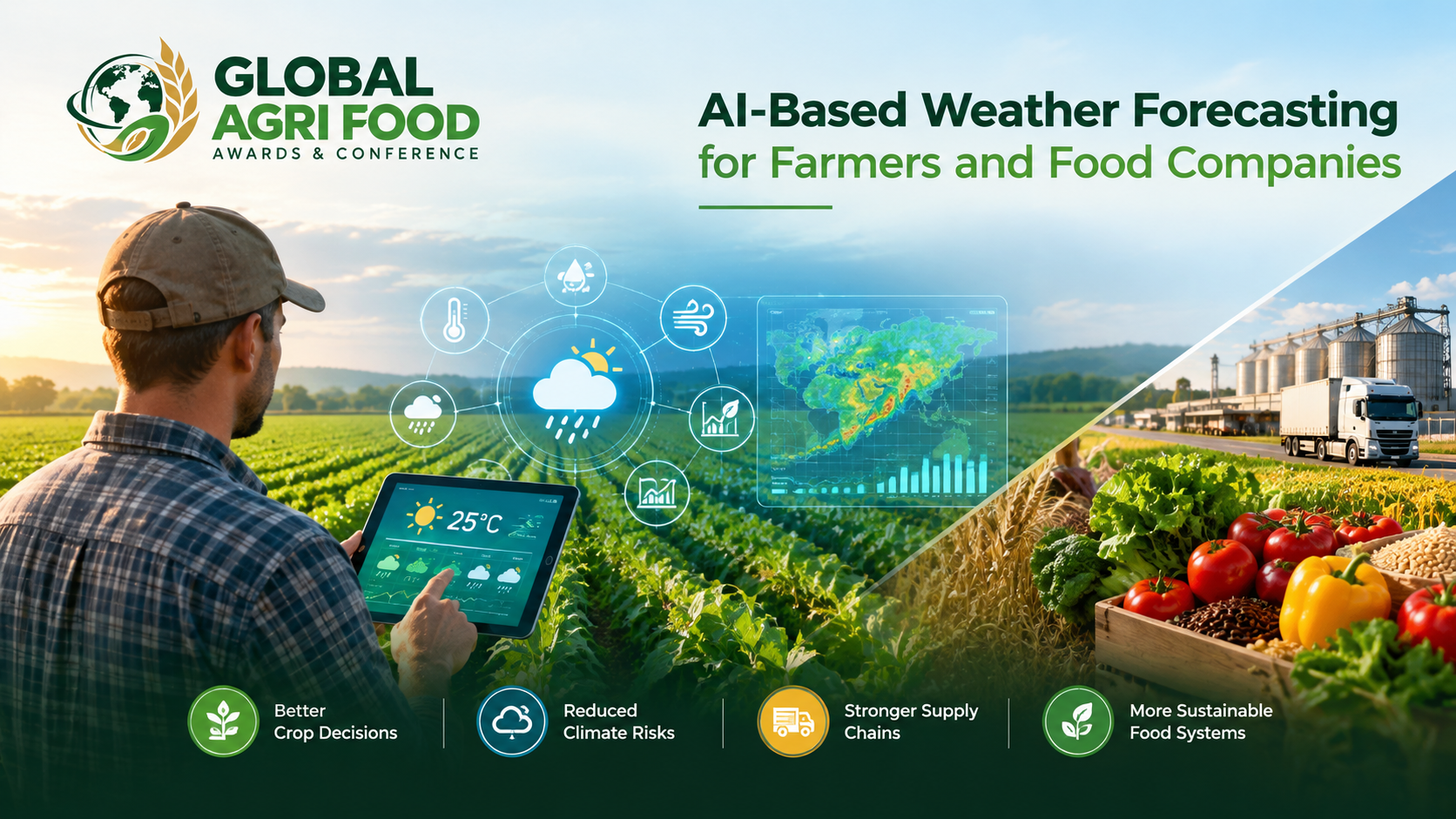
AI-Based Weather Forecasting for Farmers and Food Companies
Weather has always played a crucial role in agriculture and food production. From deciding when to plant crops to managing harvests, transporting fresh produce, and maintaining food inventories, weather conditions influence nearly every stage of the agri-food supply chain.
Unpredictable rainfall, heatwaves, droughts, frost, and extreme weather events can cause crop losses, disrupt transportation, increase operating costs, and threaten food security. Traditional weather forecasts remain essential, but farmers and food companies increasingly need more localized, timely, and actionable information.
Artificial intelligence (AI) is helping meet this need. By analysing weather observations, satellite imagery, sensor readings, and historical climate data, AI-powered systems can support better decisions across the agricultural and food industries.
How AI Is Transforming Weather Forecasting
Traditional weather forecasting relies on atmospheric observations, scientific models, and historical data. AI complements these methods by identifying patterns across large datasets and helping generate predictions and risk assessments.
AI-powered forecasting systems can use:
Satellite imagery: To monitor cloud patterns, vegetation health, and environmental changes.
Weather station data: To analyse rainfall, temperature, humidity, and wind conditions.
Field sensors: To monitor soil moisture and local environmental conditions.
Historical climate records: To identify recurring weather patterns and assess potential risks.
Machine learning: To recognize complex relationships in data and improve prediction capabilities.
These technologies can help transform general weather information into insights tailored to specific farms, crops, regions, and business operations. Forecast accuracy still depends on data quality, local conditions, and the time period being predicted.
1. Helping Farmers Make Better Crop Decisions
Farmers regularly make decisions that depend on weather conditions. Planting too early, irrigating before rainfall, or harvesting immediately before a storm can affect crop yields and profitability.
AI-based forecasting can help farmers make more informed decisions by providing localized forecasts and timely alerts.
Smarter planting schedules: Farmers can use expected rainfall, temperature, and soil moisture conditions to identify potentially suitable planting windows.
Improved irrigation planning: By combining weather forecasts with soil moisture measurements and crop water requirements, AI systems can help farmers plan irrigation more efficiently.
Early warnings for extreme weather: Alerts about potential frost, heat stress, heavy rainfall, and strong winds can give farmers additional time to protect crops and equipment.
Better harvesting decisions: Forecasts can help farmers identify suitable harvesting windows, reduce weather-related losses, and coordinate labour and machinery.
These capabilities can be particularly valuable for farms operating in regions where rainfall is irregular or extreme weather events are becoming more disruptive.
2. Reducing Climate-Related Agricultural Risks
Climate variability creates significant uncertainty for agricultural production. Droughts can reduce water availability, excessive rainfall can damage crops, and prolonged heat can affect plant development and productivity.
AI-powered forecasting can help identify potential risks earlier by combining short-term weather predictions with longer-term climate information.
For example, a farmer receiving an early warning of unusually high temperatures may adjust irrigation schedules or take appropriate protective measures. Similarly, a forecast indicating heavy rainfall could help farmers plan drainage, postpone field operations, or accelerate harvesting where appropriate.
Agricultural organisations can also use weather-risk information to support regional planning, disaster preparedness, and crop insurance assessments.
Although AI cannot prevent extreme weather, it can help farmers prepare for possible impacts and make more informed risk-management decisions.
3. Improving Decisions for Food Companies
The benefits of AI-based weather forecasting extend beyond farms. Food processors, manufacturers, distributors, retailers, and agricultural traders also depend on weather-sensitive supply chains.
Weather disruptions can affect raw material availability, transportation routes, production schedules, storage requirements, and consumer demand.
AI-driven forecasting can help food companies anticipate these challenges and adjust their operations.
Raw material procurement: Food manufacturers can use weather risk assessments to anticipate potential disruptions in the availability of grains, fruits, vegetables, and other agricultural commodities.
Production planning: Forecasts can help businesses adjust manufacturing schedules when weather conditions may affect deliveries or raw material supplies.
Inventory management: Companies can plan inventory levels more effectively when weather events threaten production or transportation.
Demand forecasting: Temperature, rainfall, and seasonal conditions can influence demand for certain food products. AI can combine weather information with historical sales data to support more responsive inventory planning.
By incorporating weather intelligence into operational planning, food businesses can improve preparedness and reduce avoidable disruptions.
4. Strengthening Cold Chains and Food Logistics
Food products such as dairy, meat, seafood, fruits, and vegetables often require controlled temperatures and timely transportation. Extreme heat, flooding, storms, and road disruptions can threaten product quality and increase spoilage.
AI-based weather forecasting can help logistics teams identify potential risks along transportation routes and prepare alternative plans.
For example, a distributor expecting extreme temperatures could review refrigeration requirements and delivery schedules. A company anticipating severe rainfall might explore alternative routes or adjust dispatch times.
When integrated with logistics management systems, weather data can also support delivery planning, warehouse operations, and the monitoring of temperature-sensitive shipments.
These applications can help protect perishable goods, reduce waste, and improve the reliability of food distribution networks.
5. Combining AI Forecasts with Precision Agriculture
Precision agriculture uses technology to manage farming activities according to the specific needs of crops and fields. AI-based weather forecasting can strengthen this approach by adding predictive information to real-time field data.
When connected with soil sensors, irrigation systems, farm management platforms, and satellite monitoring tools, weather forecasts can support more targeted agricultural decisions.
For instance, an intelligent irrigation system may combine soil moisture readings with expected rainfall before recommending whether irrigation is necessary. Similarly, weather predictions can help farmers schedule fertiliser application or crop protection activities under suitable conditions.
The goal is not simply to collect more data, but to translate information into practical actions that help improve resource efficiency and farm productivity.
6. Challenges in Adopting AI-Based Weather Forecasting
Despite its potential, AI-based forecasting faces several challenges.
Data availability: Many rural areas lack dense weather station networks or reliable historical records, limiting the quality of localized predictions.
Infrastructure and connectivity: Farmers may have limited access to smartphones, reliable internet, sensors, or digital farming platforms.
Affordability: Advanced forecasting services and connected equipment can be expensive for smaller farms and agricultural businesses.
Forecast uncertainty: Even advanced models cannot predict every local weather event with complete accuracy. Users need to understand the probability and limitations of forecasts.
Integration with existing systems: Food companies may need to connect weather intelligence with procurement, inventory, logistics, and production software.
Addressing these challenges will require investment in digital infrastructure, accessible tools, farmer education, and collaboration between technology providers, researchers, governments, and agricultural organisations.
7. The Future of AI-Driven Weather Intelligence
The future of agricultural weather forecasting will likely involve greater integration between AI models, satellite observations, ground sensors, and farm management platforms.
As these systems develop, weather intelligence may become more personalized, helping individual farmers and food businesses understand how forecast conditions could affect their specific operations.
AI-powered decision-support tools could also provide recommendations in local languages, deliver alerts through mobile devices, and help users compare different responses to potential weather risks.
For food companies, integrating weather forecasts with supply chain analytics could improve procurement planning, strengthen operational resilience, and support more reliable food distribution.
However, the greatest value will come from combining AI-generated insights with local expertise, agricultural knowledge, and sound decision-making.
Conclusion
AI-based weather forecasting is becoming an important tool for building a more resilient and efficient agri-food industry. By helping farmers plan planting, irrigation, and harvesting activities, while enabling food companies to anticipate supply chain disruptions, these technologies can support better decisions across the entire food value chain.
As climate uncertainty continues to challenge agricultural production and food distribution, collaboration between farmers, technology developers, researchers, and industry leaders will be essential to unlocking the full potential of AI-driven weather intelligence.
The opportunity is clear: turning weather data into actionable insights can help the agri-food industry prepare for uncertainty, use resources more efficiently, and strengthen food system resilience.
Join the Global Agri Food Awards & Conference 2027
The Global Agri Food Awards & Conference (GAFC) brings together agricultural innovators, food industry professionals, technology providers, investors, and decision-makers to exchange ideas and explore emerging developments shaping the future of agriculture and food.
The conference offers a platform to discuss technologies such as artificial intelligence, precision agriculture, climate-smart farming, and digital supply chain solutions, while connecting with stakeholders working to advance the global agri-food sector.
Upcoming editions:
Dubai, UAE: 13–14 April 2027
Amsterdam, Netherlands: 14–15 September 2027
Learn more: globalagrifoodconference.com