Drones, Sensors, and Computer Vision in Modern Agriculture
Agriculture is entering a new era in which data, automation, and intelligent technologies are transforming how food is produced. Farmers are increasingly turning to digital tools to monitor crops, manage resources, identify potential problems, and improve productivity. Among the most influential technologies driving this transformation are agricultural drones, smart sensors, and computer vision.
Together, these technologies enable farmers to gather real-time information about their fields, detect problems earlier, and make more informed decisions. As agriculture faces growing pressure to improve efficiency, reduce waste, and adapt to climate change, these innovations are becoming important components of modern farming.
Understanding the Three Core Technologies
Although drones, sensors, and computer vision can operate independently, their combined use offers significant opportunities for precision agriculture.
Agricultural drones are unmanned aerial vehicles equipped with cameras and other monitoring equipment. They can capture aerial images of fields, assess crop conditions, identify irregularities, and help farmers monitor large areas more efficiently.
Smart sensors collect information about environmental and field conditions. Depending on their design, they can measure soil moisture, temperature, humidity, nutrient levels, and other factors that influence crop growth.
Computer vision uses artificial intelligence to analyse images and videos. In agriculture, it can help identify plant diseases, detect weeds, assess crop development, count fruits, and monitor the condition of agricultural products.
When these technologies work together, farmers gain a more comprehensive understanding of what is happening across their fields and where intervention may be needed.
1. Agricultural Drones: A New Perspective on Crop Monitoring
Traditional crop monitoring often requires farmers and agricultural workers to inspect fields manually. While this remains valuable, it can be time-consuming, particularly on large farms or in areas where access is difficult.
Agricultural drones offer a faster way to observe field conditions from above.
Equipped with standard or multispectral cameras, drones can capture detailed images that reveal differences in crop growth, vegetation health, and field conditions. Some systems can also collect thermal information to help identify temperature variations that may indicate water stress or other problems.
Key applications include:
Crop health monitoring: Identifying areas where crops may be growing unevenly or experiencing stress.
Irrigation assessment: Highlighting potential problem areas that require further investigation.
Field mapping: Creating detailed maps to support planting, fertilisation, and other farm operations.
Pest and disease surveillance: Helping identify unusual crop patterns that may indicate an emerging problem.
Precision spraying: Supporting targeted application of agricultural inputs where permitted and appropriate.
Drones can help farmers identify where closer inspection is needed instead of treating every part of a field in the same way.
However, aerial imagery does not always reveal the exact cause of a problem. Farmers may still need ground inspections, soil testing, or expert advice before deciding on the appropriate response.
2. Smart Sensors: Bringing Real-Time Data to the Farm
While drones provide a broad view of agricultural fields, sensors can deliver continuous measurements from specific locations.
Soil moisture sensors, weather stations, temperature monitors, and connected irrigation systems help farmers understand changing conditions throughout the growing season.
For example, soil moisture sensors can measure the amount of water available in the root zone. When this information is combined with weather forecasts and crop requirements, farmers can make better-informed irrigation decisions.
Sensors can support several important farming activities:
Water management: Monitoring soil moisture can help farmers avoid unnecessary irrigation and reduce water waste.
Environmental monitoring: Temperature and humidity readings can help identify conditions associated with crop stress or disease risk.
Greenhouse management: Connected sensors can support the control of temperature, humidity, ventilation, and irrigation.
Storage and post-harvest management: Temperature and humidity sensors can help monitor conditions in grain storage facilities, warehouses, and cold chains.
Livestock monitoring: Wearable and environmental sensors can help track animal activity, location, and surrounding conditions.
The usefulness of sensor technology depends on accurate installation, regular maintenance, reliable connectivity, and the ability to interpret the collected data.
3. Computer Vision: Helping Machines Understand Crops
Computer vision is expanding the ability of agricultural systems to identify and classify visual information.
By analysing photographs and video, AI-powered systems can detect patterns that may be difficult or time-consuming for humans to assess across large areas.
For example, computer vision models can be trained to distinguish crops from weeds, identify visible disease symptoms, estimate fruit counts, and assess the maturity of certain produce.
Its applications include:
Weed detection: Identifying weeds among crops to support more targeted weed management.
Disease identification: Flagging visible symptoms that may indicate fungal infections, pest damage, or nutrient deficiencies.
Crop counting: Estimating plant populations or counting fruits to support production planning.
Harvest readiness: Analysing visual characteristics such as colour, size, and maturity to help determine when certain crops may be ready for harvesting.
Quality inspection: Examining fruits, vegetables, and other agricultural products for visible defects during sorting and processing.
Computer vision can improve consistency and speed, but its performance may vary with lighting, image quality, crop varieties, and local growing conditions. Suspected diseases or deficiencies may require expert confirmation.
4. Integrating Drones, Sensors, and Computer Vision
The greatest potential often comes from combining these technologies rather than using them separately.
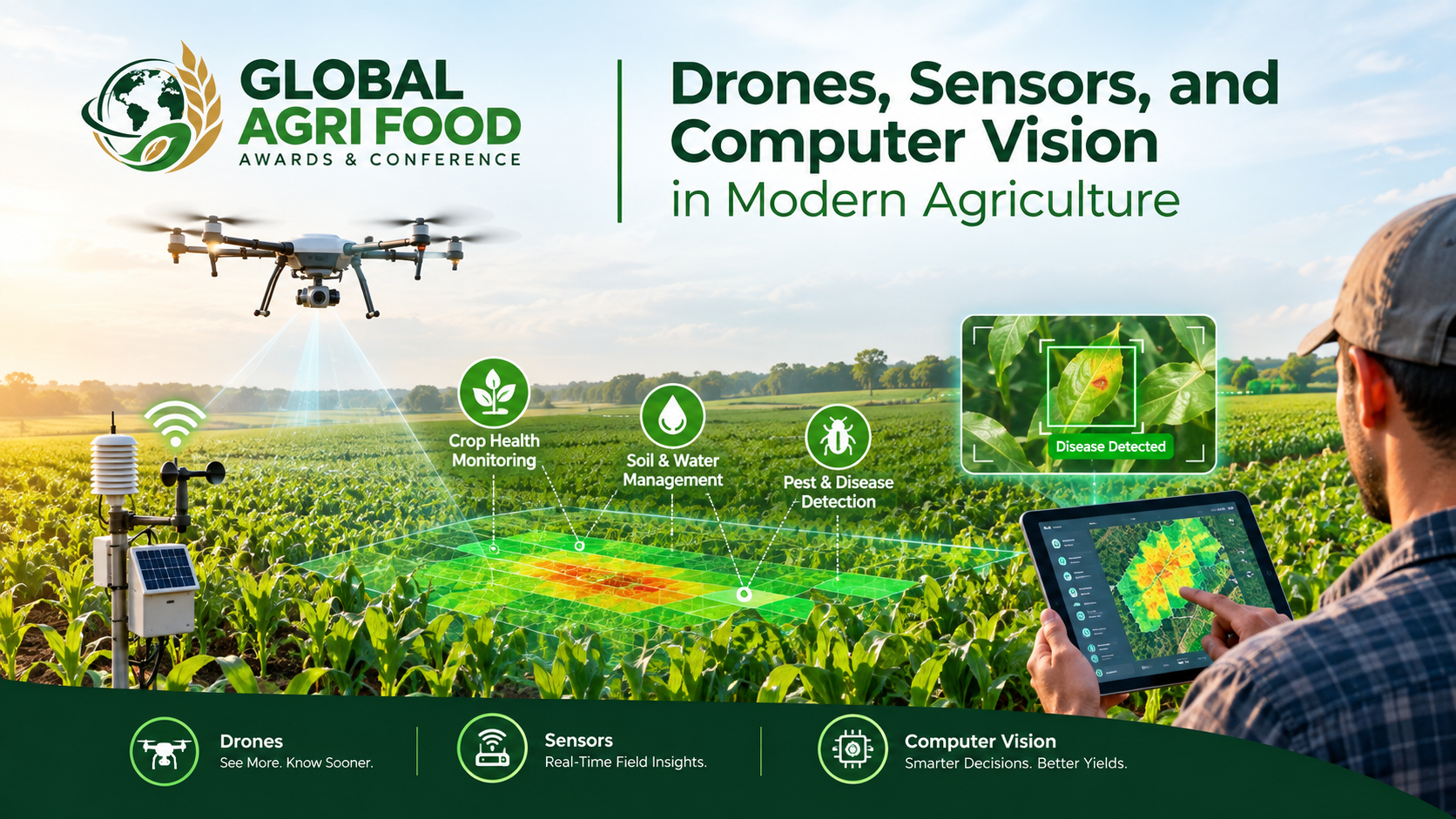
Consider a farm experiencing uneven crop growth. A drone captures aerial images that reveal areas of concern. Computer vision analyses those images and identifies unusual vegetation patterns. Soil sensors then provide additional information about moisture conditions in the affected areas.
By combining these findings, the farmer can investigate whether the problem may be related to irrigation, nutrient availability, pests, or another factor.
A similar approach can support greenhouse operations, orchards, vineyards, and large-scale commercial farms.
An integrated precision agriculture system may follow this process:
Collect data: Drones, sensors, and connected equipment gather information from the field.
Analyse conditions: AI and computer vision identify patterns, irregularities, or potential risks.
Generate insights: A farm management platform presents findings through maps, dashboards, or alerts.
Take action: Farmers adjust irrigation, inspect affected crops, or apply targeted treatments where necessary.
Monitor results: New data helps assess whether the intervention improved conditions.
This process supports a more responsive approach to farm management, allowing decisions to be guided by actual field conditions rather than relying exclusively on fixed schedules.
5. Benefits for Farmers and the Wider Food Industry
The advantages of these technologies extend beyond individual farms. Better agricultural monitoring can improve planning and coordination throughout the agri-food supply chain.
Greater resource efficiency
Targeted irrigation, fertilisation, and crop protection can help reduce unnecessary use of water, fertilisers, and pesticides when supported by reliable data and appropriate agronomic practices.
Improved crop management
Earlier detection of potential problems gives farmers more time to investigate and respond before issues become more widespread.
Reduced labour-intensive monitoring
Automated imaging and sensor networks can reduce the time required for routine inspections, allowing agricultural workers to focus on tasks requiring human judgement.
Better production forecasting
Crop health measurements, plant counts, and growth monitoring can help farmers estimate potential yields and communicate more effectively with buyers and distributors.
Improved food quality and traceability
Computer vision and connected sensors can support product grading, quality inspection, and the monitoring of storage and transportation conditions.
For food manufacturers, agricultural cooperatives, distributors, and retailers, these improvements can contribute to more predictable supply, better quality control, and more efficient operations.
6. Challenges in Adopting Agricultural Technology
Despite their potential, drones, sensors, and computer vision are not equally accessible to every farmer.
High initial costs: Equipment, software subscriptions, maintenance, and training may create barriers for small farms.
Connectivity limitations: Rural areas without reliable internet or mobile networks may struggle to use connected systems effectively.
Data management: Multiple devices can generate large quantities of information, requiring suitable platforms to organise and interpret it.
Technical expertise: Farmers need practical training to understand system outputs and translate them into appropriate agricultural decisions.
Accuracy and reliability: Poorly calibrated sensors, low-quality images, and models trained on unsuitable datasets can produce misleading results.
Regulatory requirements: Drone operations and agricultural spraying are subject to local rules, which vary by country and activity.
Addressing these challenges will require affordable technology, accessible training, dependable technical support, and solutions designed around the practical needs of farmers.
Cooperatives, agricultural service providers, and technology partnerships can help make these tools more accessible by allowing multiple farms to share equipment and expertise.
7. The Future of Smart and Precision Agriculture
The next stage of agricultural innovation will likely involve closer integration between drones, sensors, computer vision, robotics, and AI-powered farm management systems.
Autonomous agricultural machines may increasingly use cameras and sensors to navigate fields, identify individual plants, and carry out specific tasks. Predictive analytics could combine field observations with weather forecasts to help farmers anticipate potential problems. Robotics may also support selective harvesting, targeted weed control, and automated crop inspection.
Another important development is the use of edge computing, which allows some data processing to take place directly on devices rather than relying entirely on cloud connectivity. This can be useful in remote agricultural areas where internet access is limited.
As these technologies develop, their success will depend not only on technical performance but also on affordability, ease of use, data security, and their ability to deliver measurable value to farmers.
The goal is not to replace agricultural knowledge and experience. It is to give farmers better information and practical tools to support their decisions.
Conclusion
Drones, sensors, and computer vision are changing how farmers observe crops, monitor field conditions, and manage agricultural resources. By combining aerial imagery, real-time measurements, and AI-powered image analysis, these technologies can help identify problems earlier, improve resource efficiency, and support more informed farm management.
Their impact can extend throughout the food industry, from production forecasting and quality inspection to storage, distribution, and supply chain planning.
Although challenges remain in cost, connectivity, accuracy, and adoption, continued innovation and collaboration can help make precision agriculture more accessible and effective.
The future of agriculture will depend increasingly on the ability to turn reliable data into timely action, helping farmers produce food more efficiently while building more resilient and sustainable agricultural systems.
Join the Global Agri Food Awards & Conference 2027
The Global Agri Food Awards & Conference (GAFC) brings together agricultural innovators, technology providers, food industry professionals, investors, and decision-makers to explore emerging technologies and opportunities shaping the future of agriculture and food.
The conference provides a platform to exchange insights, discuss developments in precision agriculture and digital farming, and connect with stakeholders working to advance the global agri-food industry.
Upcoming editions:
Dubai, UAE: 13–14 April 2027
Amsterdam, Netherlands: 14–15 September 2027
Learn more about the conference: globalagrifoodconference.com