
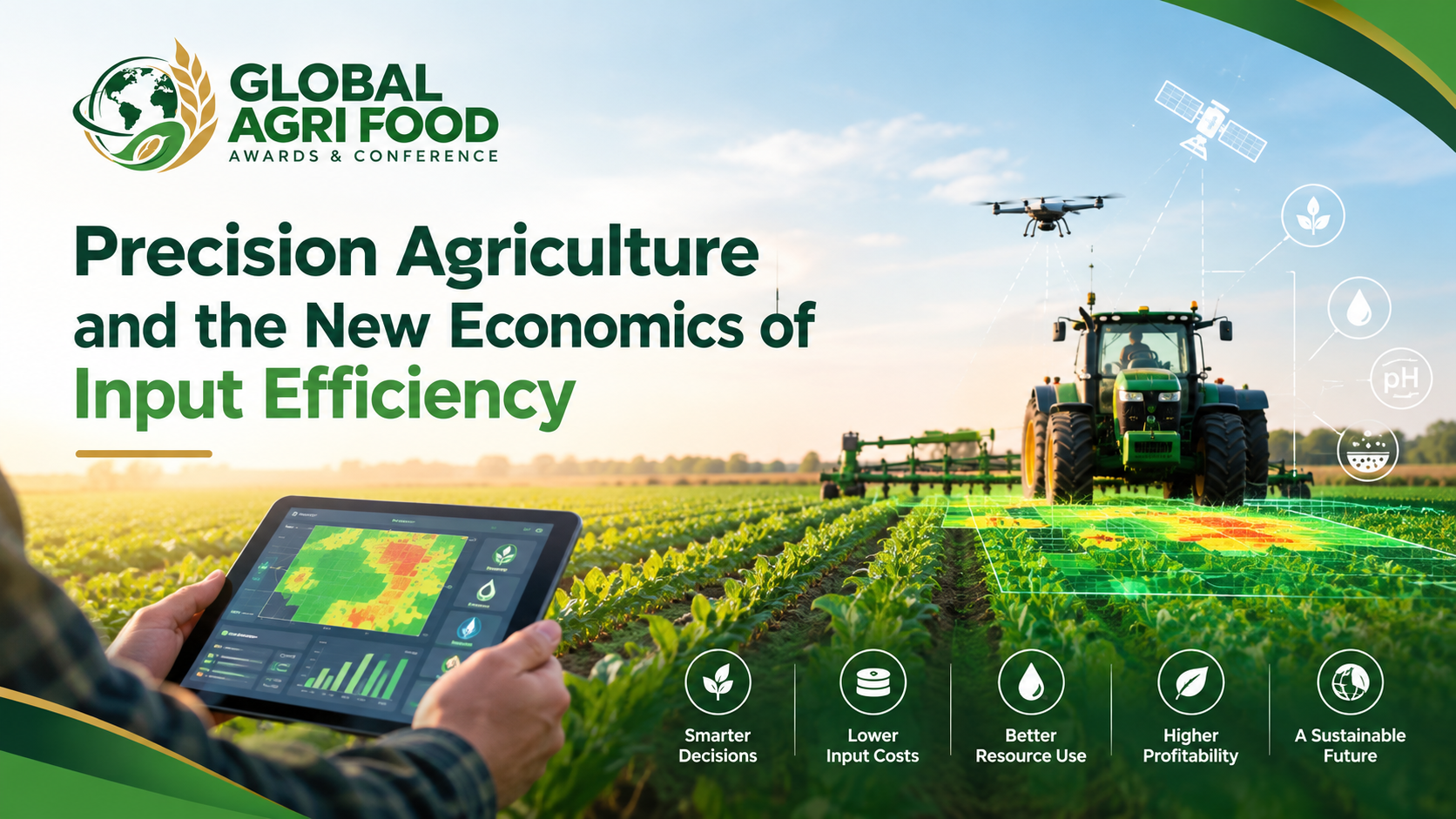
Precision Agriculture and the New Economics of Input Efficiency
Agriculture is facing a growing economic challenge: producing more food while managing rising input costs, limited natural resources, and increasing environmental pressures. Fertilizers, pesticides, water, fuel, and labor are essential to modern farming, but using more of them does not always translate into better yields or higher profits.
This is where precision agriculture is changing the way farmers approach production. By combining data, digital technologies, and targeted farming practices, precision agriculture helps farmers make more informed decisions about where, when, and how much to apply.
The result is a shift in agricultural economics — from focusing primarily on maximizing production to improving the efficiency and profitability of every input used.
What Is Precision Agriculture?
Precision agriculture is a farming approach that uses data and technology to manage variations within agricultural fields. Rather than treating an entire field as if every section has identical needs, farmers can make decisions based on differences in soil conditions, crop health, moisture levels, nutrient availability, and other factors.
Technologies such as GPS-guided machinery, satellite imagery, drones, soil sensors, artificial intelligence (AI), and variable-rate application systems support this approach.
For example, a field may contain areas with different nutrient requirements. Applying the same fertilizer quantity across the entire field may lead to overapplication in some areas and insufficient application in others. Precision agriculture can help identify these differences and adjust applications accordingly.
The objective is not simply to use less. It is to use resources where they deliver the greatest agronomic and economic value.
Why Input Efficiency Is Becoming an Economic Priority
Agricultural profitability depends on the relationship between production costs and the value of the resulting harvest. When input prices rise or crop prices fluctuate, even small inefficiencies can affect a farm's financial performance.
Several factors are making input efficiency increasingly important.
1. Rising and Unpredictable Input Costs
Fertilizers, fuel, crop protection products, and other agricultural inputs can represent substantial operating expenses. Their prices may fluctuate due to energy markets, supply chain disruptions, geopolitical conditions, and seasonal demand.
Precision agriculture helps farmers evaluate input requirements more accurately. By identifying areas that need attention, they may reduce unnecessary applications and improve the return on their spending.
2. Limited Water and Natural Resources
Water scarcity and soil degradation are placing additional pressure on agricultural systems. Applying water or nutrients beyond what crops can effectively use may increase costs while creating environmental risks.
Precision irrigation, soil monitoring, and data-driven nutrient management can help align resource use with actual field conditions.
3. Greater Pressure to Demonstrate Sustainability
Farmers and agricultural businesses are increasingly expected to demonstrate responsible resource management. Precision agriculture can support more efficient fertilizer application, better water management, and improved records of farming practices.
These benefits may also help businesses respond to sustainability requirements from customers, supply chains, and regulators, although outcomes depend on the technologies and practices adopted.
Five Technologies Reshaping Input Efficiency
1. Variable-Rate Technology
Variable-rate technology allows farmers to adjust the amount of seed, fertilizer, or crop protection product applied across different areas of a field.
Instead of applying a uniform rate everywhere, equipment uses field data and prescription maps to vary application rates according to specific requirements.
This approach can help reduce overapplication, improve resource allocation, and address differences in soil fertility or crop performance.
Its economic value depends on the accuracy of the underlying data, the cost of the equipment, and whether field variability is significant enough to justify different application rates.
2. Satellite Imagery and Drone Monitoring
Satellite imagery and drones allow farmers to monitor crop development across large areas. Depending on the sensors and analytical methods used, these tools can help identify vegetation differences, water stress, and potential problem areas.
Early identification can help farmers investigate issues before they become more serious. Rather than applying the same treatment across an entire field, they can assess whether a targeted response is more appropriate.
However, imagery alone does not always identify the underlying cause of crop stress. Field inspections and agronomic knowledge remain important for making the right decision.
3. Smart Irrigation Systems
Water management is one of the clearest examples of how precision agriculture can improve input efficiency.
Soil moisture sensors, weather data, and irrigation management software can help farmers determine when and where irrigation is needed. Some systems can also automate irrigation schedules based on defined conditions.
By aligning water application with crop requirements, farmers may reduce unnecessary pumping, conserve water, and avoid conditions associated with overwatering.
In regions where water and energy are expensive or scarce, these improvements can have meaningful financial value.
4. Artificial Intelligence and Predictive Analytics
AI systems can analyze agricultural data from sensors, machinery, weather services, and historical records to identify patterns and support decision-making.
Predictive tools can help estimate crop water requirements, detect unusual crop conditions, forecast potential disease risks, and compare possible management strategies.
For example, a farmer may use a decision-support system to evaluate whether additional fertilizer is likely to provide sufficient yield benefits to justify its cost.
AI does not eliminate uncertainty, but it can help farmers make decisions using more information than traditional observation alone.
5. Connected Machinery and Farm Management Software
Modern agricultural machinery can collect information about planting rates, fuel consumption, equipment performance, and field operations.
When connected to farm management software, this information can help farmers identify inefficiencies, plan maintenance, and compare the performance of different fields or practices.
Over time, these records can reveal where costs are increasing and which operational changes may deliver the greatest financial benefit.
Measuring the Return on Investment
The economics of precision agriculture go beyond the purchase price of technology. Farmers need to understand whether the investment produces measurable improvements in profitability.
A useful starting point is to evaluate the total cost of adopting a technology against the financial benefits it generates.
These costs may include:
Equipment purchases or upgrades.
Sensors, software subscriptions, and connectivity.
Data analysis and technical support.
Staff training and changes to existing workflows.
Maintenance and ongoing service costs.
Potential benefits include reduced input waste, lower fuel and labor expenses, more efficient machinery use, improved crop performance, and better-informed operational decisions.
Consider a farm that invests in precision fertilizer application. If the technology reduces unnecessary fertilizer use without compromising crop performance, the savings may contribute directly to profitability. If it also improves yield in nutrient-deficient areas, the economic benefit could be greater.
However, savings are not guaranteed. A farm with relatively uniform soil conditions may experience fewer benefits than one with substantial field variability. Each technology should therefore be evaluated against local conditions, crop requirements, and actual operating costs.
The Hidden Challenge: Access to Technology
Although precision agriculture offers considerable potential, adoption remains uneven.
Large agricultural businesses may have the capital, technical teams, and equipment needed to implement advanced systems. Smaller farms may face greater barriers, particularly when initial investments are high or reliable digital infrastructure is unavailable.
Several approaches can make precision technologies more accessible.
Service-based models: Farmers can hire drone operators, agronomy specialists, or precision application providers instead of purchasing every piece of equipment themselves.
Shared machinery and cooperatives: Farmer groups can share the cost of equipment, software, and technical expertise.
Affordable digital tools: Mobile applications and lower-cost sensors can help farmers begin with specific needs rather than investing in a fully connected farming system.
Phased implementation: Starting with one measurable challenge, such as irrigation efficiency or fertilizer management, can help farmers assess results before expanding their investment.
The goal should be practical adoption that delivers value, not technology adoption for its own sake.
Precision Agriculture and Sustainable Farming
Input efficiency has economic benefits, but it also has important environmental implications.
More targeted fertilizer use can help reduce nutrient losses. Improved irrigation management can support water conservation. Better crop monitoring can help farmers identify where crop protection measures may be needed.
These practices can contribute to more sustainable agricultural production when implemented correctly.
Nevertheless, efficiency improvements must be evaluated carefully. Reducing an input below the level required for healthy crop development can lower yields and may create other problems. The most effective approach balances productivity, profitability, and environmental responsibility.
Precision agriculture can support this balance by giving farmers better information about the relationship between their decisions and their outcomes.
What Does the Future Hold?
The next phase of precision agriculture will likely involve deeper integration between AI, robotics, autonomous machinery, remote sensing, and digital farm management systems.
As technologies become more connected, farmers may be able to monitor crop conditions, identify input requirements, generate application plans, and assess economic outcomes through integrated platforms.
The focus will increasingly shift from collecting data to turning it into practical decisions. Farmers will need tools that explain not only what is happening in a field, but also which response is likely to make economic sense.
Interoperability, data ownership, affordability, and ease of use will remain important. Technology providers that can demonstrate measurable benefits under real farming conditions will be better positioned to build trust and encourage wider adoption.
Ultimately, the future of precision agriculture will depend on how effectively it connects digital intelligence with practical farming knowledge.
Global Agri Food Conference: Advancing Agricultural Innovation
As precision agriculture reshapes input management, collaboration between farmers, technology providers, researchers, investors, and agricultural businesses will be essential to accelerating innovation.
The Global Agri Food Awards & Conference (GAFC) brings together professionals and stakeholders to explore emerging agricultural technologies, sustainable farming practices, investment opportunities, and developments shaping the future of the agri-food industry.
Upcoming editions:
13–14 April 2027 — Dubai, UAE
14–15 September 2027 — Amsterdam, Netherlands
The conference offers a platform for industry professionals to exchange ideas, discuss practical challenges, build partnerships, and explore opportunities across agriculture and food systems.
Learn more at globalagrifoodconference.com
Final Thoughts
Precision agriculture is changing how farmers think about productivity and profitability. Instead of relying solely on applying more resources to achieve higher yields, farmers can use data and technology to identify where inputs are needed and how effectively they are being used.
The economic opportunity lies in making better decisions — reducing unnecessary spending, improving resource allocation, and understanding the relationship between input costs and crop performance.
Although adoption requires investment and careful planning, precision agriculture can help farms build more efficient and resilient operations when the technology is suited to their needs.
In the evolving economics of agriculture, competitive advantage will increasingly depend not on how much a farm uses, but on how effectively it turns every input into value.