
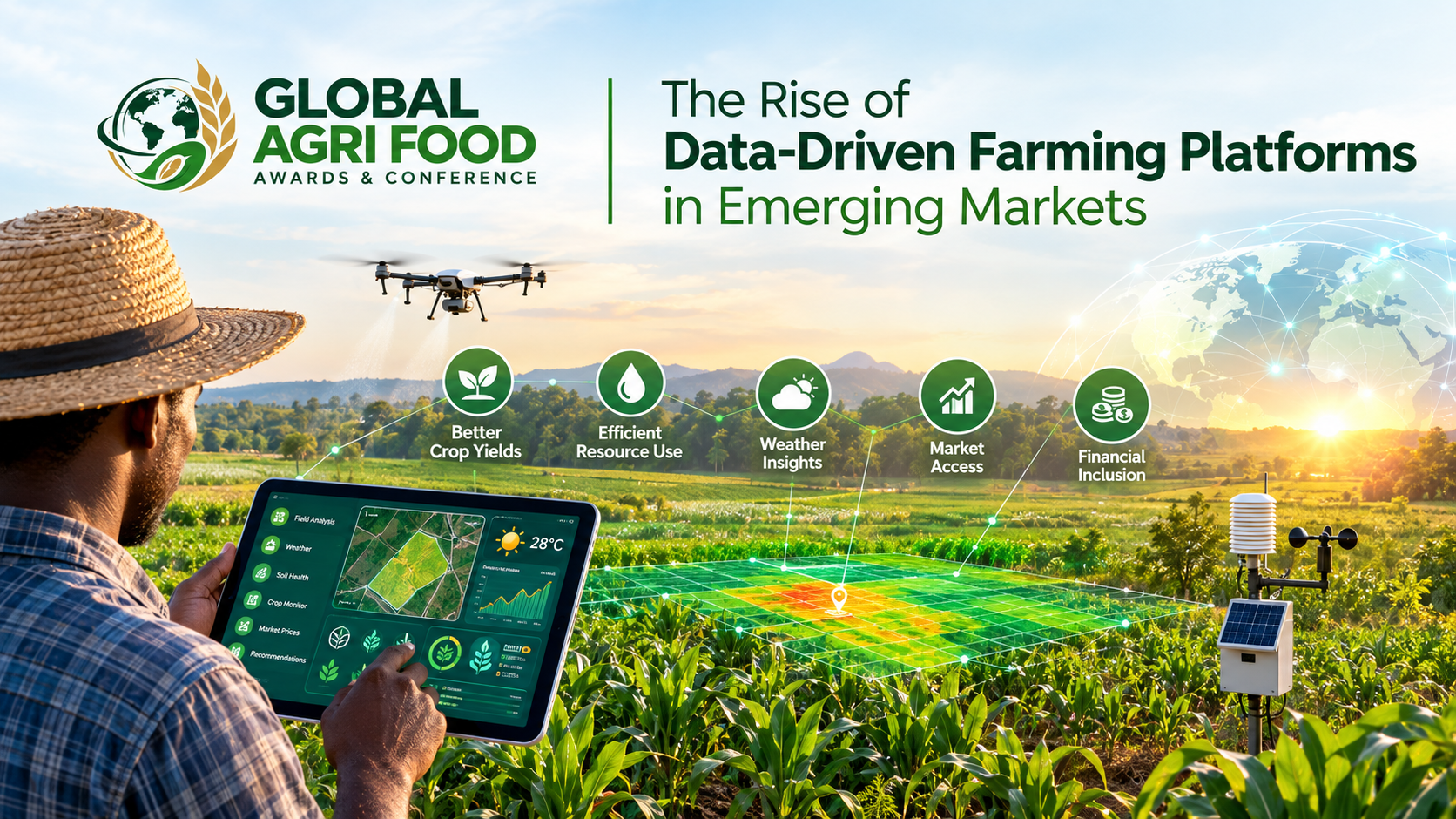
The Rise of Data-Driven Farming Platforms in Emerging Markets
Agriculture is undergoing a digital transformation. Across emerging markets in Africa, Asia, and Latin America, farmers and agribusinesses are increasingly exploring digital platforms to improve productivity, manage resources, access markets, and make better-informed decisions.
For decades, many agricultural decisions have relied on traditional knowledge, seasonal patterns, and local experience. While these remain valuable, changing weather conditions, rising input costs, supply chain challenges, and growing food demand are creating a need for additional tools and information.
Data-driven farming platforms are emerging as an important part of this transition. By combining agricultural data, artificial intelligence (AI), satellite imagery, mobile technology, and digital marketplaces, these platforms can help farmers connect information with practical action.
As digital infrastructure expands and agritech innovation accelerates, emerging markets are becoming an important area of opportunity for the future of data-driven agriculture.
What Are Data-Driven Farming Platforms?
Data-driven farming platforms are digital systems that collect, analyse, and organise agricultural information to support decisions across the farming lifecycle.
Depending on their design, they may combine information about soil conditions, weather forecasts, crop health, farm inputs, market prices, and production performance. Some platforms focus on farm management, while others connect farmers with buyers, financial services, agricultural advisers, or suppliers.
These platforms can help farmers understand what is happening on their farms, identify potential risks, and make decisions based on a wider range of information.
Common capabilities include:
Farm management tools: Recording planting schedules, input usage, field activities, and crop performance.
Weather intelligence: Providing forecasts and alerts to support planting, irrigation, and harvesting decisions.
Crop monitoring: Using satellite imagery, drones, and field observations to assess crop conditions.
Digital marketplaces: Connecting farmers with buyers, suppliers, processors, and distributors.
Financial services: Supporting access to agricultural credit, insurance, and digital payments where available.
AI-powered recommendations: Analysing available data to provide guidance on farm operations and resource use.
The goal is to make agricultural information more accessible and useful, particularly for farmers who have historically had limited access to digital advisory services and organised markets.
1. Why Emerging Markets Are Driving Agritech Innovation
Emerging markets face distinct agricultural challenges, but they also present significant opportunities for digital innovation.
In many regions, agriculture supports millions of livelihoods, yet farmers may face limited access to reliable market information, modern equipment, financing, and specialised agricultural advice.
At the same time, growing smartphone adoption, digital payment systems, improved connectivity, and investment in agritech are creating new ways to deliver services.
Several factors are accelerating adoption.
Growing demand for agricultural productivity: Farmers need practical ways to improve yields, manage costs, and make better use of land and water.
Access to market information: Digital platforms can help farmers compare prices, discover potential buyers, and improve their understanding of market demand.
Climate uncertainty: Weather intelligence and crop monitoring tools can support preparation for droughts, floods, and changing growing conditions.
Expansion of digital services: Mobile applications and messaging-based services can bring agricultural information closer to farmers without requiring expensive computer infrastructure.
Investment in agricultural technology: Startups, established businesses, development organisations, and investors are exploring scalable solutions for persistent agricultural challenges.
These developments are creating opportunities for platforms designed around local farming practices, languages, infrastructure, and business needs.
2. Artificial Intelligence and Agricultural Data
Artificial intelligence is expanding what data-driven farming platforms can offer.
AI systems can analyse information from multiple sources, identify patterns, and help users understand potential risks or opportunities. When supported by reliable data and appropriate models, these capabilities can strengthen agricultural planning.
For example, AI-enabled platforms may combine weather forecasts, soil information, and crop growth data to support irrigation decisions. Image analysis can help identify possible crop stress, while predictive models may assist with estimating yields or anticipating pest risks.
In emerging markets, these tools could be especially valuable where access to agricultural specialists is limited.
However, successful implementation requires more than advanced algorithms. Data must reflect local crops, soil conditions, climate patterns, and farming practices. Recommendations should also be understandable, affordable, and practical for the people using them.
AI is most useful when it supports farmers' knowledge rather than treating technology as a replacement for local expertise.
3. Digital Marketplaces and Stronger Agricultural Supply Chains
One of the most important opportunities for data-driven farming platforms lies beyond the farm itself.
Farmers may produce high-quality crops but still struggle to reach buyers, negotiate prices, arrange transportation, or find suitable storage facilities. Digital marketplaces can help address some of these challenges by connecting producers with processors, wholesalers, retailers, and other market participants.
These platforms can support:
Improved visibility into market prices and buyer demand.
More direct connections between farmers and potential purchasers.
Better coordination of aggregation, transportation, and deliveries.
Digital records of transactions and product availability.
Improved communication between producers and food companies.
For food processors and agricultural commodity buyers, digital platforms can provide better visibility into sourcing opportunities and potential supply constraints.
However, marketplaces must build trust, maintain reliable product information, and establish workable logistics and payment systems. Technology alone cannot resolve every challenge in fragmented agricultural supply chains.
4. Financial Inclusion Through Agricultural Data
Access to financing remains a major challenge for many smallholder farmers and agricultural businesses. Without sufficient capital, producers may struggle to purchase quality seeds, fertilisers, machinery, or irrigation equipment.
Data-driven platforms may help improve access to financial services by organising records of farm activity, production history, transactions, and other relevant information.
Where appropriate and with suitable consent, lenders and insurers may use this information alongside conventional assessments to better understand agricultural businesses and evaluate potential risks.
Digital tools can also simplify applications, facilitate payments, and support the delivery of insurance products.
For example, weather and satellite data may contribute to agricultural insurance models that assess certain environmental risks. Digital transaction records may also help demonstrate a farm business's commercial activity.
Nevertheless, data-driven finance must be implemented responsibly. Farmers need transparency about how their information is used, and automated assessments should not unfairly exclude producers who lack digital records or reliable connectivity.
5. The Role of Data in Climate-Smart Agriculture
Climate change is increasing pressure on agricultural systems, making better information increasingly important.
Data-driven platforms can help farmers monitor weather conditions, assess crop stress, improve irrigation planning, and explore practices that use resources more efficiently.
By integrating weather forecasts, soil moisture readings, satellite imagery, and crop information, these systems can support more informed responses to changing environmental conditions.
Potential applications include:
Water management: Helping farmers make irrigation decisions based on field conditions and expected rainfall.
Crop planning: Providing information to support decisions about planting schedules and crop suitability.
Risk monitoring: Delivering alerts about potentially damaging weather conditions.
Resource efficiency: Helping identify opportunities to reduce unnecessary use of water, fertilisers, and other agricultural inputs.
Climate adaptation: Supporting the evaluation of different farming practices and their suitability under changing conditions.
The impact depends on the quality of recommendations and the resources available to implement them. Digital advice must be paired with appropriate infrastructure, financing, and agricultural support to produce meaningful results.
6. Challenges Facing Data-Driven Farming Platforms
Despite their potential, data-driven farming platforms face several barriers in emerging markets.
Connectivity and digital infrastructure
Rural communities may experience unreliable internet access, limited mobile coverage, or inconsistent electricity supply. Platforms should therefore consider offline functionality, low-bandwidth services, and accessible mobile interfaces.
Affordability
Subscription fees, smartphones, sensors, and other equipment can be costly for smallholder farmers. Affordable pricing and partnerships with cooperatives, agricultural organisations, and service providers may improve access.
Digital literacy and local relevance
A platform may fail to deliver value if users cannot easily understand its recommendations. Local-language support, practical training, and user-centred design are essential.
Data quality and interoperability
Agricultural information may be incomplete, inconsistent, or spread across disconnected systems. Platforms need reliable data collection methods and, where possible, the ability to work with existing agricultural services.
Trust and data protection
Farmers need confidence that their data will be handled responsibly. Clear consent processes, transparent policies, and appropriate safeguards are important for long-term adoption.
Sustainable business models
Many agritech businesses must balance affordability for farmers with the cost of developing, maintaining, and supporting their platforms. Revenue models may involve subscriptions, transaction fees, business-to-business services, or partnerships with financial institutions and agricultural organisations.
Addressing these challenges will be critical to ensuring that digital agriculture delivers lasting value rather than remaining limited to pilot projects.
7. From Pilot Projects to Scalable Agricultural Solutions
Agricultural technology companies often demonstrate promising results through pilot projects. Scaling these solutions across different regions, however, requires a deeper understanding of local markets and farming systems.
A platform that works well in one country may require significant adaptation in another because of differences in crops, languages, regulations, infrastructure, and supply chains.
Successful expansion often depends on several factors:
Local partnerships: Working with cooperatives, agribusinesses, research institutions, and agricultural extension services.
Practical value: Demonstrating measurable benefits such as improved market access, lower operating costs, or better resource management.
Flexible technology: Designing services that can adapt to different crops, farm sizes, and connectivity conditions.
Farmer participation: Involving farmers in product development and gathering feedback throughout implementation.
Commercial sustainability: Establishing business models that support ongoing service delivery and long-term growth.
The strongest platforms will be those that solve specific agricultural problems and demonstrate clear value for the people who use them.
8. The Future of Data-Driven Farming in Emerging Markets
The next phase of digital agriculture is likely to involve more connected systems that bring together farm management, AI, financial services, market access, and supply chain intelligence.
Farmers may increasingly use integrated platforms to manage production records, receive personalised recommendations, compare input options, and connect with buyers. Agribusinesses may use shared data systems to improve procurement, traceability, inventory planning, and supplier relationships.
Advances in satellite technology, mobile services, affordable sensors, and AI could make these capabilities more accessible over time.
There is also an opportunity for locally developed agritech companies to create solutions that reflect regional needs rather than simply adapting products designed for other markets.
Achieving this potential will require collaboration among technology developers, farmers, investors, policymakers, research institutions, and established agricultural businesses.
The future of digital farming will not be determined by technology alone. It will depend on whether these platforms are accessible, trusted, commercially sustainable, and capable of delivering meaningful improvements in agricultural livelihoods and food systems.
Conclusion
Data-driven farming platforms are becoming an important part of agricultural transformation in emerging markets. By connecting farm-level information with AI-powered analysis, digital marketplaces, financial services, and supply chain tools, they can help farmers and agribusinesses make better-informed decisions.
Their potential extends beyond improving individual farm operations. These platforms can support stronger connections between producers and buyers, improve agricultural planning, and create new opportunities for innovation across the food value chain.
However, long-term success will depend on addressing infrastructure gaps, affordability, data quality, digital literacy, and trust. Solutions must be designed around the realities of local farming communities and demonstrate practical value at scale.
As emerging markets continue to embrace digital innovation, data-driven farming platforms have the potential to help build more productive, resilient, inclusive, and sustainable agri-food systems.
Global Agri Food Awards & Conference 2027 (GAFC)
The Global Agri Food Awards & Conference (GAFC) brings together agricultural innovators, agritech companies, food industry professionals, investors, and decision-makers to explore the technologies and ideas shaping the future of agriculture and food.
As data-driven agriculture, AI, digital farming, and sustainable food production continue to evolve, GAFC provides a platform for industry stakeholders to exchange insights, showcase innovation, discuss emerging opportunities, and build valuable professional connections.
The conference welcomes perspectives from across the agri-food value chain, including technology developers, producers, processors, investors, and organisations working to improve agricultural productivity and food system resilience.
Upcoming editions:
Dubai, UAE: 13–14 April 2027
Amsterdam, Netherlands: 14–15 September 2027
Whether you are developing an agritech solution, investing in agricultural innovation, or transforming food supply chains, GAFC offers an opportunity to connect with professionals and explore the future of the global agri-food industry.
Learn more: globalagrifoodconference.com