
I’ve reviewed the official globalagrifoodconference.com . I’ll incorporate the event’s actual details into the blog, including its Dubai and Amsterdam 2027 editions, focus areas, awards, innovation showcase, and opportunities for startups to connect with investors, buyers, and industry leaders.
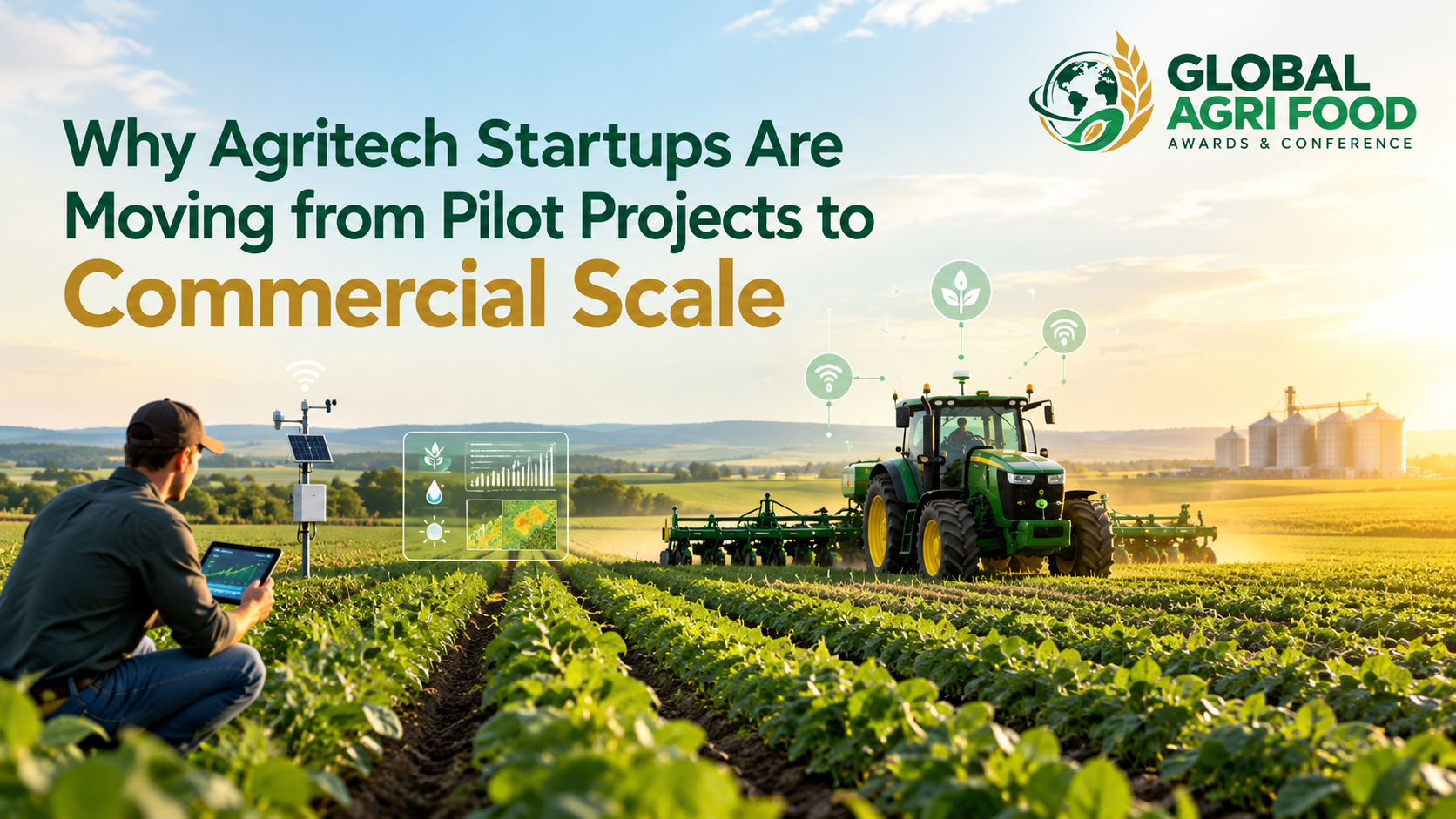
Why Agritech Startups Are Moving from Pilot Projects to Commercial Scale
Agriculture is entering a new era of technological transformation. For years, agritech startups have focused on testing innovative solutions through pilot projects, small-scale trials, and partnerships with farmers. These initiatives have helped businesses validate their technologies, understand agricultural challenges, and demonstrate their potential value.
Today, the industry is witnessing a significant shift. More agritech startups are moving beyond experimentation and focusing on commercial expansion, sustainable business models, and wider market adoption.
From precision farming and AI-powered crop monitoring to smart irrigation, agricultural robotics, and digital supply chains, startups are working to bring proven solutions to larger farming communities and commercial markets. This transition reflects a growing recognition that agricultural innovation must deliver measurable results, generate sustainable revenue, and address the practical needs of farmers.
But what is driving this shift, and why is commercial scalability becoming a priority for agritech companies?
1. Growing Demand for Practical Agricultural Solutions
Farmers worldwide face mounting pressure from unpredictable weather, rising input costs, water scarcity, soil degradation, and changing market conditions. Traditional farming practices remain essential, but agricultural businesses are increasingly exploring technologies that can improve efficiency and reduce operational risks.
Agritech startups are responding with solutions designed to address these challenges. Precision agriculture platforms help farmers make informed decisions about fertilizer application, irrigation, and crop protection. AI-powered analytics can support early identification of crop stress, while digital platforms improve access to market information and agricultural services.
As farmers become more aware of the potential benefits of these technologies, demand is shifting from experimental demonstrations toward solutions that can be integrated into everyday agricultural operations.
For startups, this creates an opportunity to move beyond isolated pilot projects and develop scalable products that serve a broader customer base.
2. Proven Results Are Building Market Confidence
Pilot projects play an important role in agricultural innovation because they allow startups to test technologies under real farming conditions. However, successful trials alone are rarely enough to establish a sustainable business.
Commercial adoption depends on demonstrating consistent value. Farmers and agricultural enterprises want evidence that a solution can improve productivity, reduce waste, lower costs, or strengthen resilience across different conditions.
For example, a smart irrigation system may demonstrate promising water savings on a small farm. To scale commercially, its developers must show that the system remains reliable across different soil types, farm sizes, climates, and irrigation practices.
Startups that demonstrate repeatable results are better positioned to gain customer trust, secure distribution partnerships, and attract investment.
The focus is therefore shifting from proving that a technology works to demonstrating that it delivers measurable economic value and can be adopted at scale.
3. Investors Are Prioritizing Sustainable Business Models
Investment in agritech has evolved alongside broader changes in the startup funding environment. While innovative concepts can attract early attention, investors increasingly look for clear evidence of commercial viability.
Startups need a defined customer base, a credible revenue model, a realistic path to profitability, and a strategy for expanding into new markets.
Some are adopting subscription-based software models, while others generate revenue through equipment sales, service contracts, technology licensing, or partnerships with agricultural input suppliers.
For startups offering farm management software, monitoring platforms, and data-driven advisory services, recurring revenue can be particularly valuable.
Those that align their pricing and business models with agricultural realities are better equipped to turn early traction into long-term growth.
4. Strategic Partnerships Are Accelerating Expansion
Scaling an agritech business independently can be difficult. Agricultural markets are fragmented, farming practices vary by region, and reaching customers in rural areas often requires established local networks.
Strategic partnerships can help overcome these barriers.
By collaborating with cooperatives, agricultural input distributors, equipment manufacturers, food processors, agribusinesses, and financial institutions, startups can access new customers and expand their market presence more efficiently.
For example, a startup developing precision farming software may partner with an established agricultural equipment provider to integrate its technology into existing machinery. A digital marketplace may work with farmer cooperatives to improve access to agricultural products and buyers.
These partnerships can reduce customer acquisition costs, build credibility, and provide access to infrastructure that would otherwise take years to develop.
As a result, commercial expansion is increasingly becoming a collaborative process rather than a journey startups undertake alone.
5. Artificial Intelligence and Digital Infrastructure Are Maturing
Advances in artificial intelligence, remote sensing, satellite imagery, connected devices, and cloud computing are creating new opportunities for agritech companies.
Startups can combine multiple data sources to provide farmers with insights into crop health, weather patterns, irrigation needs, and potential production risks. Digital platforms also make it easier to distribute software-based agricultural services across larger geographical areas.
However, technology alone does not guarantee successful scaling. Solutions must work with inconsistent internet connectivity, limited digital literacy, diverse farm sizes, and varying levels of technological readiness.
Startups that design affordable, reliable, and user-friendly products around these realities have a stronger chance of converting technological progress into commercial adoption.
6. Climate Challenges Are Increasing the Need for Scalable Innovation
Climate change is making agricultural planning more complex. Changing rainfall patterns, prolonged droughts, extreme temperatures, and emerging pest pressures are increasing uncertainty for farmers and food producers.
This has strengthened interest in technologies that support climate resilience and resource efficiency.
Agritech startups are developing solutions for precision water management, soil health monitoring, climate risk assessment, regenerative agriculture, and more efficient use of agricultural inputs.
For these technologies to make a meaningful difference, their impact must extend beyond individual demonstration farms.
Commercial scaling allows successful solutions to reach more farmers, support larger agricultural operations, and contribute to broader sustainability goals. It can also help startups establish stronger relationships with food companies, sustainability-focused investors, and organizations working to improve agricultural resilience.
The challenge is to ensure that environmental benefits are accompanied by measurable economic value for the farmers expected to adopt these solutions.
7. Farmers Are Becoming More Selective About Technology Adoption
As more digital tools enter the agricultural market, farmers are increasingly evaluating technologies based on practical outcomes rather than novelty alone.
A product may generate considerable interest during a demonstration, but widespread adoption depends on whether it fits into existing workflows and delivers sufficient value for its cost.
Farmers want solutions that are dependable, easy to use, compatible with their equipment, and supported by responsive service providers. They also need confidence that a technology will continue to work throughout the growing season.
This makes customer support, training, maintenance, and after-sales service essential parts of commercial expansion.
Agritech startups that invest in customer relationships and local support networks can build stronger retention, generate referrals, and establish more predictable revenue streams.
Ultimately, scaling in agriculture requires more than selling a product. It requires creating a solution farmers are willing and able to use over the long term.
8. Overcoming the Challenges of Commercial Scaling
Despite the opportunities, moving from pilot projects to commercial scale remains challenging.
Agritech startups frequently encounter several barriers:
High deployment costs: Hardware, installation, logistics, and maintenance can make expansion expensive.
Long sales cycles: Farmers and large agricultural organizations may require multiple seasons of evidence before adopting new technologies.
Limited access to finance: Companies need sufficient capital to support product development, distribution, hiring, and customer acquisition.
Regional differences: Solutions that perform well in one agricultural environment may require adaptation for another.
Data and connectivity constraints: Incomplete agricultural data and limited internet access can affect product performance.
Demonstrating return on investment: Startups must show that the benefits justify the cost for their target customers.
Addressing these challenges requires careful planning. Rather than expanding everywhere at once, successful startups can prioritize specific crops, customer segments, or geographical markets where their solutions have demonstrated the strongest results.
This focused approach helps companies refine their products, build reliable distribution channels, and establish a repeatable commercial model before entering additional markets.
9. Industry Events Are Creating Opportunities for Agritech Startups
As agritech startups expand, access to the right industry networks, business partnerships, investors, and potential customers becomes increasingly important.
Commercial scaling often requires collaboration across borders, particularly when companies are looking to introduce their solutions to new agricultural markets. Industry conferences and business networking platforms can help startups connect with established agribusinesses, technology providers, investors, policymakers, researchers, and potential buyers.
These connections can create opportunities for strategic partnerships, distribution agreements, investment discussions, and knowledge exchange.
One platform bringing these stakeholders together is the Global Agri Food Awards & Conference, an international event focused on agriculture, food innovation, technology, investment, and sustainable food systems. The event features conference sessions, an innovation showcase, an awards programme, and curated networking opportunities.
Global Agri Food Dubai 2027
13–14 April 2027
Dubai, United Arab Emirates
An international meeting point for agriculture, food security, agritech, investment, and food innovation.
Global Agri Food Amsterdam 2027
14–15 September 2027
Amsterdam, Netherlands
A second international edition connecting stakeholders across agriculture, food systems, technology, and business.
Dates and locations: official event website.
How can the event support agritech startups?
The Global Agri Food platform offers several opportunities relevant to startups working to commercialize agricultural innovations.
Industry networking: Connect with producers, food companies, technology providers, investors, policymakers, and international buyers.
Innovation showcase: Present emerging technologies and practical solutions designed to improve agricultural and food systems.
Speaking opportunities: Share expertise, research, case studies, and lessons learned from deploying agricultural technologies.
Awards and recognition: Put forward an eligible company, product, service, or individual for recognition of their contribution to agriculture and food innovation.
Exhibition and partnerships: Explore opportunities to demonstrate products, increase industry visibility, and build relationships with potential collaborators.
For startups moving beyond pilot projects, these opportunities can complement their commercial strategy by helping them communicate their achievements, build credibility, and explore connections with organizations that may support future expansion.
Recognition and networking alone cannot guarantee commercial success. However, when combined with proven product performance, a clear business model, and a well-defined market strategy, industry engagement can become a useful part of a startup's growth journey.
Learn more about participation, awards, speaking, and exhibition opportunities on the globalagrifoodconference.com .
10. What Commercial Scaling Means for the Future of Agritech
The shift from pilot projects to commercial scale represents a broader change in how agricultural innovation is evaluated.
The next phase of agritech growth will likely favor companies that combine technical expertise with strong business fundamentals, farmer-focused product design, and effective partnerships.
Startups will need to demonstrate measurable agricultural outcomes while developing business models capable of supporting long-term operations. They will also need to balance growth with affordability, ensuring that advanced technologies remain accessible to the farmers and agricultural communities that can benefit from them.
For investors and industry stakeholders, this creates an opportunity to support companies moving beyond promising prototypes toward dependable, market-ready solutions.
For farmers, it could mean greater access to technologies that improve decision-making, strengthen productivity, and support more resilient agricultural practices.
For the wider food system, successful scaling could help connect innovation with the practical demands of food security, resource conservation, and sustainable production.
Conclusion
Agritech startups are moving from pilot projects to commercial scale because the industry increasingly demands solutions that deliver measurable value in real-world agricultural settings. Stronger demand for practical technologies, maturing digital infrastructure, changing investment expectations, strategic partnerships, and growing climate pressures are all contributing to this transition.
Yet commercial success will depend on more than technological advancement. Startups must understand farmers' needs, demonstrate consistent results, build sustainable revenue models, and establish the partnerships required to reach new markets.
Industry platforms such as the Global Agri Food Awards & Conference 2027 also provide opportunities to highlight innovation, strengthen professional networks, and encourage collaboration across the agriculture and food ecosystem.
With its Dubai and Amsterdam editions, Global Agri Food brings together stakeholders working across agriculture, food technology, investment, and sustainability, creating a platform for exchanging ideas and exploring opportunities that can help shape the future of the sector.
Explore the Global Agri Food Awards & Conference 2027: globalagrifoodconference.com